“We read five words on the first page of a really good novel and we begin to forget that we are reading printed words on a page; we begin to see images – a dog hunting through garbage cans, a plane circling above Alaskan mountains, an old lady furtively licking her napkin at a party. We sip into a dream, forgetting the room we’re sitting in, forgetting it’s lunchtime or time to go to work.” — John Gardner, “On Becoming a Novelist.”
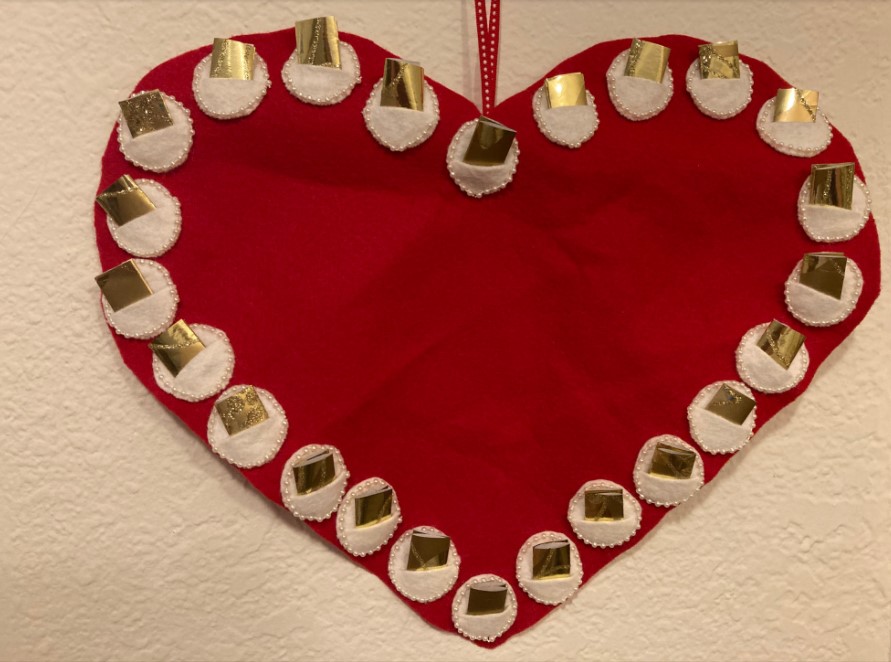
Photo and heart, by Susan Lawrence
We hear a lot about being grateful, giving thanks, gratitude lists, and silver linings.
But what if you just aren’t feeling it?
How about creating a hygge calendar? I read about this in a Facebook group.
Make a list of things to be mindful about, a way to help get out of the doldrums and into a feeling of calm, care, and positivity.
Pay attention to one item each day.
Personalize your calendar and use it as advent calendar, or as a way of looking at old things in a new way.
Hygge: A quality of coziness and comfortable conviviality that engenders a feeling of contentment or well-being, regarded as a defining characteristic of Danish culture.
Hygge Advent Calendar ideas, or a list of how to create a feeling of coziness:
1. Light a candle during meals.
2. Chalk a friendly greeting on a sidewalk.
3. Share an uplifting poem or a story with friends.
4. Bundle up and sit outside in the evening with twinkle lights.
5. Read children’s books about Christmas and winter.
6. Drive around and look at Christmas lights
7. Hold or look at an item that belonged to a beloved family member, or a beloved friend.
8. Phone a family member or a friend, just to say hello. Talk about a fun or memorable event you shared.
9. Make something, it could be a baked item or a craft item.
10. Sit outside for ten minutes and look at trees.
11. Write a thank you note or a note just to say “Hi, I’m thinking about you.” Mail it!
12. Boil cinnamon and orange peels to make the house smell good.
13. Turn off all lights except for a candle or two (recommend battery operated). Get comfy under a warm blanket. Sit with the quiet.
14. Look at family photos.
15. Send a donation or donate your time to helping others.
16. Make a nest of pillows and read a familiar and cozy book.
17. Stand at a window and gaze at the view.
18. Donate money or food to a food bank.
19. Make paper snowflakes.
20. Spend some time with a neighborhood pet.
21. Take a few, deep, nourishing breaths. Breathe in. Breathe out.
22. Soak feet in mineral salts while listening to music.
Thank you, Susan Lawrence, a speech therapist, in Los Angeles for this inspiration. Susan created her Hygge advent calendar by making a heart shaped wall hanging with pieces of gold paper, each one has a cozy activity written on it and placed in the pockets randomly.
Matthew Félix
Guest Blogger Matthew Félix shares his rebound from doubt.
“Doubt is the Devil! Show doubt, and he’ll be back!”
I woke up with the quote resounding in my mind. It was as though an old woman were standing over me waving her finger, scolding me to make sure I got the point.
A couple of weeks earlier, I had received the comments on my novel from my editor. Like a tsunami coming out of nowhere (or, in this case, raging up the coast from Santa Barbara), twelve pages of feedback wiped out half the world I’d spent so many years building.
I expected it. I wanted it. Nevertheless, in the days and weeks that followed I was overcome by wave after wave of self-doubt, at times nearly drowning in it.
Was I up for the challenge? Did I have the energy to make the changes? And, by the way, what changes? My editor pointed out the problems, she didn’t provide the solutions. It was my book. Addressing the issues was my job. Could I figure it out? Did I still even want to try?
Some days, as I considered what needed to be done and how to do it, the path forward seemed to open effortlessly before me. I felt good. I felt motivated and inspired. On others, I slammed up against a wall, struggling in vain to address confounding roadblocks. I stared listlessly at the computer, accomplishing nothing, my eyes bloodshot, a trickle of saliva dangling from my mouth, the floor under my chair like at a barber shop, covered with hair I’d pulled out in frustration.
Then I woke up to the quote.
I thought about how much support I’d received, especially recently. Things had fallen into place in ways I never could have imagined, ways that exceeded my expectations. I had been presented with perfect places to write over the coming months. I suddenly didn’t have to worry about major expenses I had been anticipating. Countless words, gestures, and signs had encouraged me to keep going.
Self-doubt suddenly seemed self-indulgent.
After all, what purpose did it serve? What purpose does it ever serve? Other than giving us excuses to let ourselves off the hook, if we choose to buy into it? Other than granting us license to avoid the challenges and obstacles from which we have the most to learn?
“Show doubt, and he’ll be back!”
Not only was doubt subversive, it was self-perpetuating. The more I indulged it, the more it got under my skin, like the poison-oak infection I scratched until it spread to my eye and sealed it shut. Giving doubt my attention only made it stronger, blinding me to reality.
It was time to open my eyes.
It was time to show my gratitude for all the support, guidance, and inspiration that continued to come my way. It was time to renounce doubt and embrace faith, in myself, in my novel, in something greater that had gotten me this far and would get me through to the end.
The dream was a wake-up call.
Enough self-indulgent, counterproductive doubt.
Time to send the Devil packing.
Note From Marlene: I have had the joy of experiencing Matthew and his illuminating talks about book marketing. I learn something new every time. He is a gem in the treasure chest of book marketing.
Matthew’s latest book, Porcelain Travels, won Gold for Humor in the 2019 Readers’ Favorite Awards and was a Foreword INDIES Book of the Year Award finalist. Its stories were awarded Gold, Silver, and Bronze Solas Awards, as well as the First and Third Prizes in Humor in the 2020 Soul-Making Keats Literary Competition.
Adventure, humor, and spirituality infuse Matthew’s work, which often draws on his time living in Spain, France, and Turkey, as well as travels in more than fifty countries.
“I am a rescuer of stories hidden among the ordinary. I give these stories voice as a template to inspire others with untold stories so that they will know the satisfaction of rescuing their own stories.” – Nancy Cullen
My BLOG, THE STONEBRIDGE, began as a place I could record and share stories. Stories stemming from four areas outlined on the BLOG’s “About” page. It is my version of a Sacred Bundle, a practice began by my father.
Capturing, or as I like to say, rescuing, stories from our thoughts, memories, and obscurity is a learned skill. There are processes, template frameworks, and yes, a bit of discipline involved. These are not apparent as one reads a particular post but run in the background like a good operating system in a computer.
Although, not complex, nonetheless they must be identified and adapted to your own style. Once in place, becoming a hero at rescuing stories feels natural.
My Hero Model Template
My father was a quiet example of a story rescuer. His method was quite simple, as were the tools he used:
his thoughts and observations
a quiet place to think and write
paper
a manual typewriter
My tools are the same, except I have replaced the typewriter and paper with a laptop and this BLOG.
Dad wrote during quiet hours in the office at “The Shop,” his place of business where he sold new and used auto parts.
He stored his writing in a dark blue vinyl satchel. Occasionally he would let one of us read these musings.
I write in my “vision room,” then store them on this BLOG for the world to read, comment on, and, I hope, receive inspiration.
Find Your Personal Why
How can you become a Hero at Rescuing Your Valuable Stories?
First, define why rescuing stories is important, then why it is important to you. This is a great support in not only getting started, but to remain consistent when life conspires to derail your efforts.
The “why,” for me, comes from either discovering some delightful piece of information previously lost or losing a significant person in my life and realizing how much passed with them.
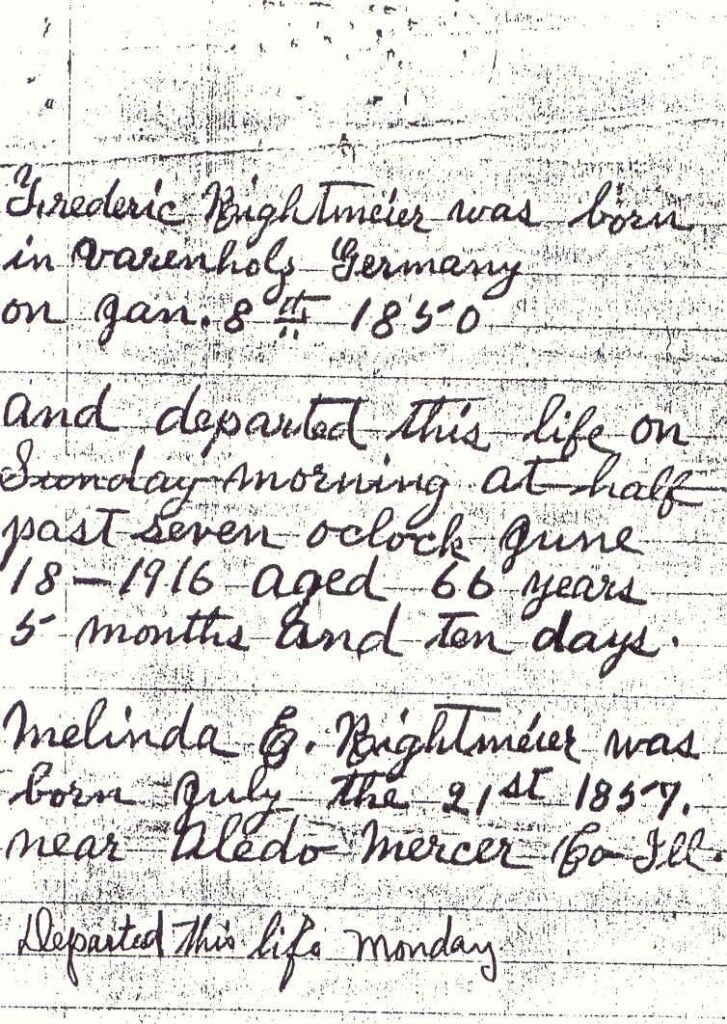
An example of the former was an entry in the Rightmeier family bible about my maternal great-great grandfather’s birthplace in Germany. It was discovering a piece of my own history. That piece of information eventually resulted in me traveling to the German village mentioned in the notation.
Of course, the loss of a person from this earth is sorrowful, but the loss of their stories for lack of recording only compounds that sorrow. Taking the time to write these down is a way to preserve their legacy.
There are many other “whys” for rescuing stories. What is your “why?”
Your Hero Model
Second, what kind of stories do you want to record? Your personal observations of:
daily life
family events or conversations
the story behind specific objects and what they represent
For instance, a collection of seashells. Where were they collected? What was the occasion? Who were you with? That painting that was always present, where did it come from?
Third, assemble your own simple tool kit. Decide a time, place, and means where these rescued stories will be recorded and stored. Look for ways to fit “rescuing” into your life routine, for example:
Use a voice recorder during your daily commute or walk
Journal each morning, evening, or once a week, with thoughts and details on your chosen topic
Catch ideas as they fly by on a digital voice recording or App such as Evernote or OneNote
Tried and true paper files still work!
A Place To Start
Below is a template as an aid in deciding what kind of stories to rescue along with some suggested ways to begin “storing” them.
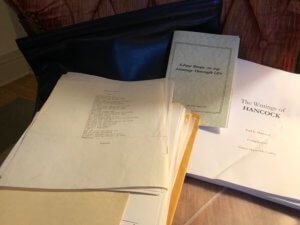
I inherited Dad’s writings and have compiled them into a book. It is an example of what is possible with humble tools. It can be viewed and purchased by clicking on this link.
What kind of story will you rescue this week?
Nancy J. Cullen grew up in Rooks County, Kansas, where she was introduced to aviation by her father. Flying in the same airplane she now owns, her early days of traveling with her dad to rural destinations, landing in pastures, grass airstrips and attending local fly-ins lay vivid in her memory.
What she did not realize was that her father was also cultivating another legacy he would pass on to her: writing. Other than the technical writing she did over her 30+ years as a federal civil servant, an air traffic controller, and air traffic staff support both in the United States and Europe, she had no aspirations to write.
It was not until her father passed on to her his writings, what she called his “sacred bundle” did the desire to rescue stories come to life for her. She has preserved his writings in a self-published book, “The Writings of HANCOCK.”
Since 2013 she has developed her own writing platform through her BLOG, The Stonebridge, where she shares her rescued stories and endeavors to inspire others to begin their own rescue operation.
Nancy holds the Premier Degree in French from the University of Strasbourg, France. She is a private pilot and owner of a 1961 Aircoupe she has restored twice and assists in its annual maintenance. She and her husband of 43 years own a 133-year-old Kansas State Historic Landmark home in Historic Midtown, Wichita, KS which they are in the process of restoring. She serves at the Chairperson of the PBS Kansas Citizens Advisory Board and actively participates in several aviation groups, locally, nationally, and internationally.
She inherited the EAA Biplane project from her father which she is building with the support of the local Experimental Aircraft Association chapter.
Note from Marlene: I have wondered why we humans seem to easily focus on the negative and sometimes have difficulty seeing the positive.
The following from Qi Gong teacher Lee Holden explains why we tend to think about things that cause stress and anxiety:
The nature of the mind is to dream and wander. Even when the present moment is completely perfect, it’s normal for thoughts to run off into the past or future.
Sometimes, daydreaming can provide valuable insights that lead to joy. However, most of the time, the mind isn’t quite so generous. More often than not, the mind’s natural tendency is to ruminate on thoughts that produce stress or anxiety.
Luckily, Qi Gong provides powerful tools for calming the mind and returning to peace. In this article, we’ll discuss the nature of human thinking, as well as share three techniques to quickly calm your busy mind.
Understanding the Human Mind
Why is it that humans tend to think about things that cause stress and anxiety? Why can’t we naturally gravitate toward thoughts that bring us to a place of joy?
Back when humans faced life-threatening situations on a regular basis, it was helpful to have a mind that could quickly identify unwelcoming circumstances. As such, the mind evolved to constantly look for signs of danger and plan for the worst.
For hunter-gatherers who lived in cold climates, it was necessary to consider how much food they needed to gather before the winter. Without thinking about the future, they might not reach the spring. Naturally, this created a tendency for the mind to constantly search for possible threats.
In modern life, most of the threats we face aren’t nearly as severe as those of our ancestors. Instead of fighting off jaguars, our stressors usually take the form of traffic lights, long lines at the grocery store, work meetings, and getting our kids to school on time. However, internally, we still respond to these “threats” in a similar way as we do to those that are truly life-threatening.
While it’s certainly a good idea to get your kids to school on time and prepare for important work meetings, most of the stress and busy thinking we experience doesn’t actually help us.
More often than not, stress and busy thinking make it harder to concentrate and cause emotional fatigue. Not only does this feel uncomfortable, but it also reduces our ability to function at a high level.
In order to experience inner peace and outer resilience, it’s important for us to not let stress and busy thinking get the best of us.
Fortunately, as conscious creatures, we can choose to work with our mind and body to let go of patterns of stress and overthinking.
Three Qi Gong techniques to Quickly Calm Your Busy Mind
1. Slow Deep Breathing
In Qi Gong, the breath is seen as an important gateway between the mind and body. Breathing is an opportunity to use the intention of the mind to work with the body, and the presentness of the body to work with the mind.
The quality of your breath is closely linked to your level of stress and the busyness of your thoughts. When feeling stressed, breathing becomes quick and shallow.
When you’re relaxed and calm, it slows down and becomes deep and full.
One of the quickest ways to calm a busy mind is to take slow, deep breaths.
To start, sit upright in a chair. Bring your full attention to your breath and inhale slowly through your nose, allowing your abdomen and chest to fill up with nourishing oxygen.
At the top of your inhale, hold your breath for two to three seconds.
Then exhale slowly through your nose until your lungs are completely empty.
At the bottom of your exhale, hold your breath for another two to three seconds.
You can do this simple breathing exercise for as short or long as you’d like. If you’re busy, perhaps just take five to ten breaths in this manner.
If you have more time, follow this breathing practice with some physical activity.
2. Engage Your Body
Just as breath and thinking are closely connected, your body and mind often reflect the quality of one another.
When your mind is racing with busy thoughts, the body often becomes tense and tight. In turn, this causes energy to stagnate, which creates additional discomfort and propels the cycle of busy thinking.
When you move your body, you’re able to release tension and tightness, which allows your mind to relax and become calmer.
There are many different kinds of physical activities you can do — hiking, running, walking, pickleball, or… Qi Gong.
3. Focus on Physical Sensations
In addition to moving your body, it’s often helpful to focus on the physical sensations that you experience in order to calm your mind.
Why?
Your body is always in the present moment, but your mind is not. By focusing your mind on physical sensations, you’re able to use your body as an anchor to bring your mind back to the present moment.
Focusing on physical sensation can take many forms. One way is just to sit still, take some deep breaths, and pay attention to whatever you’re feeling in your body.
Another way is to practice Qi Gong, which combines all three of these qualities to help calm the mind.
In Qi Gong, we often start with slow, deep breathing to relax the body and bring our attention to the present moment. Then, we work with a variety of movement exercises to release tension and circulate energy throughout our entire being. And throughout the entire practice, we cultivate a deep awareness of the physical sensations we’re experiencing.
Lee Holden has devoted his career to helping people learn the powerful principles of Qi Gong for over twenty-five years. Anybody, at any age or fitness level, can use these moving meditation techniques – not only to improve physical fitness, but also to assist in recovery from injury and illness, to achieve a deeper sense of calm, and to relieve tension and stress. Through my DVDs and Public Broadcasting television specials, in-person workshops, and teacher training, I have helped more than 10,000 students:
Heal from injury and disease
Slow the aging process
Feel better than ever
Maximize their energy
Many people tell me they don’t have access to a Qi Gong teacher in their area, or that classes aren’t at a convenient time. That’s why I’m now offering fresh classes streaming online, every week. Now, thanks to the internet, you can finally take my classes from home, whenever it’s convenient for you. It’s also why we’re producing brand new Healing Series programs to help you solve your most pressing problems. Whether you’re just getting started, or have years of practice under your belt, I’m confident that you’ll find my style of Qi Gong practical, effective, and harmonious. Looking forward to working with you!
Lee Holden
Excerpted from “Where Do You Hang Your Hammock?: Finding Peace of Mind While You Write, Publish, and Promote Your Book” by Bella Mahaya Carter.
When you’re out there promoting your book, you’ll have to ask for all sorts of things. This might feel hard. You may make up stories, such as I don’t want to “bother” people or be a nuisance. You may feel as if you have no right to ask for what you want. You may even feel, deep down, as if there’s something wrong with asking.
Of course, nobody likes rejection, either. We don’t want to hear the word “no.” But how people respond has more to do with them than with you. If you can blow by the nos, you’ll pick up enough yeses along the way. So don’t let that stop you.
Those stories running through your head, that make asking for what you want seem unsavory, doesn’t mean your ask will not be welcomed or even appreciated. I have had this experience too many times to count. Sometimes when I’ve struggled to ask a person for something, he or she is in fact happy to help. Here’s an example.
Years ago, I received an email from Jack Grapes, my old writing teacher and mentor, who published my poetry book in 2008. Jack is a well-known and beloved literary figure in Los Angeles and has been teaching for more than four decades. His email promoted an upcoming writing workshop offered by a former student of his. I wonder if he’d do the same for me, I thought, in the midst of putting together my fall writing classes.
The next day, I put “email Jack” on my to-do list. It didn’t get done. The following day, I wrote it again. Usually when I carry over an action item from one day to the next, I cross it off my list on the second day. Not this time. For a week straight, the directive “email Jack” continued to appear on my list. Why is this so hard to do? I wondered. I knew Jack loved me. I knew he respected my work. Still, asking him to do this for me felt monumental.
A week later, feeling uneasy, I forced myself to just do it.
Ten minutes after I hit the send button, I heard back from him. “I’d be happy to do that,” he responded.
A few days later, while exploring in my journal why writing and sending that email had been so hard, I realized the heart of the matter: shame. Deep down, I felt as if I shouldn’t need help, which created embarrassment and shame about asking. I worried that my request might seem needy or inappropriate. And from there, the sorry old I’m not good enough voice, a close sibling of I’m not worthy and therefore don’t deserve this, found its toehold and sprang into action, hoping I’d take the bait and fall. Once I realized that my reluctance to ask had stemmed not from a fear that he’d say no but rather from this feeling of unworthiness, something inside me released and I felt free.
How many times have you been reluctant to make a request of someone you perceived as more established, successful, or powerful than you? How often have you felt like you didn’t have the right to “bother” or “intrude upon” them? How many times have you reproached yourself, saying you shouldn’t need to ask for help? How many times have you berated yourself, thinking, I should have my shit together and not need anyone else—especially when it comes to my career?
Talk about “should-ing” all over yourself. Let’s agree right here and now to quit feeling crappy!
For years, I believed that one of the things writers needed most to succeed was chutzpah. Google defines this Yiddish word as “shameless audacity.” Some of its synonyms are “nerve,” “boldness,” and “temerity.” Hispanics use cojones, or “balls.”
I used to think writers needed balls of steel. Had my dilemma with Jack been a reminder that I needed to grow a pair, or toughen up the metaphorical ones I had?
And then it hit me: Instead of bigger balls, instead of fighting, I needed to drop down into myself, to connect with that place where absolute tenderness for and faith in myself and others reside. The key, I realized, was to be shameless in the sense of understanding that we are all worthy and that there’s nothing wrong with asking for what we want. There’s no shame in it; in fact, it’s a blessing. None of us lives alone on this planet. We are part of a community, a web of loving, supportive relationships. We all give and take all the time; these are reciprocal energies, regardless of our professional accomplishments (or perceived lack thereof). Thomas Jefferson once wrote, “Remember that no one is better than you, but that you are better than no one.”
In order to ask for what you want, you have to know what you want. Sometimes this is clear. Other times, you have inklings and intuitions. Trust your worthiness, even when you can use a little help. Especially then.
No, I’m not talking about the twenty-six letters of the English alphabet. And I’m not talking about emails, text messages, private messages and whatever electronic form of letters and messages are out there on any current platform. I’m talking about the REAL letter: the one you write in longhand (you know cursive writing, the secret code of a previous generation), fold carefully, tuck into an envelope, seal it, address it, place a postage stamp on its corner and drop it in the nearest mailbox (the snail mailbox variety, varies in color depending on what country you live in).
Letters have long been the most poignant written form of communication in any language: a means to share stories, convey important (or unimportant) messages, or, basically, just to connect. Have you written one lately? Or, perhaps you are the lucky recipient of a letter in your mailbox.
I remember, as a child, being fascinated with the pile of mail dropped through the front door slot on a daily basis (well, weekdays, that is). Mom always set aside unwanted flyers, calling them ‘Emily mail.’ I had fun opening the envelopes and pulling out the stuffing, reading the literature of countless items I would never understand let alone be interested in, and then filing them in what we used as a recycle bin in the 1960s: the fireplace. Once it was clear that I enjoyed receiving mail and actually reading it, my grandmother, fondly called Granny, and my godmother, Aunt Peg, started writing to me and I would write back. Both lines of correspondence continued well into my adult years, until the loved one passed away – Granny in 1995 and Aunt Peg, at the age of 101, in 2021. Even when these loved connections couldn’t write to me, I wrote to them – weekly at the least.
One of the most cherished letters my godmother enjoyed in the past few years was one I wrote about a recent acquisition for my garden: a Rodgers flower. Her son, Roger, was her letter-reader and he informed me that they enjoyed a chuckle over my revelation of the Rodgers flower addition to the garden that sparked the quippy comment from one of my adult children: “What’s Uncle Roger doing growing in our garden?”
So, what’s in a letter? Connectivity and love, the solace of a few written words to make someone feel special in a world gone mad, which ours definitely has. It’s also a release for the writer, to unburden the soul on paper, slowly, precisely, carefully, in elegant (or, in my case, not so elegant) script. Simply put, writing letters is an excellent way to hone one’s skills as a writer. It could be a small note on the back of a postcard, where the message has to be tight, succinct and to the point without taking up too much space. Or, it could be multiple pages of narrative and even some dialogue to carry the message to the reader in an entertaining manner.
As a writer who enjoys working in several genres, I value the art of letter-writing. I have several author friends who feel the same way and we exchange letters on a regular basis. One of these author friends lives less than a mile away and yet we still exchange letters on a weekly basis. Writing letters not only touches others and shows our appreciation, it also enriches our writing skills. So, next time you think you have writer’s block, write a letter. Or, don’t even wait for that feeling; write a letter anyway. There’s someone out there who will appreciate it and your writing will be all the better for the exercise.
Emily-Jane Hills Orford has published several books, creative nonfiction stories mostly about her family. Growing up in Toronto, then Hamilton and finally London, Emily-Jane has lots of family stories to warm the heart.
In her most recent novels, “Mrs. Murray’s Ghost,” “Mrs. Murray’s Hidden Treasure,” “Mrs. Murray’s Home,” and “Mr. Murray’s Gun” (all part of the “Piccadilly Street Series”), the author returns to her roots and the fond memories and dreams, growing up in a haunted old Victorian mansion in London, Ontario Canada.
Note from Marlene: You can also use letter writing as a warm-up to your project writing.
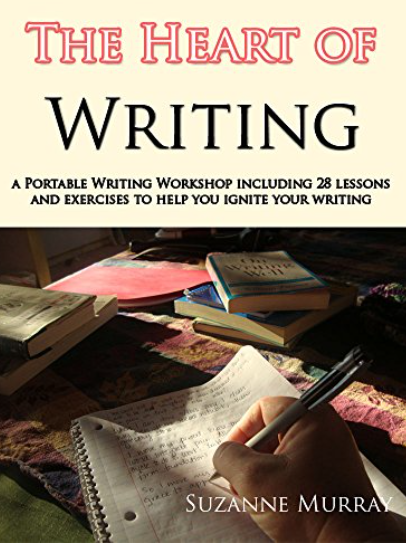
The Heart of Writing by Suzanne Murray, available at Amazon
Guest Blogger Suzanne Murray encourages creativity by surrendering.
SURRENDER IS CRITICAL TO CREATIVITY
We can’t force creativity. We know this intuitively. If we told a painter that we wanted a masterpiece by five o’clock tomorrow, they would look at us like we were crazy; that we clearly didn’t understand what being creative was all about.
An important part of being creative is learning to surrender to the flow of the universe, allowing something greater than our everyday self to move through us. It’s not something we can figure out with our linear mind. Of course, if we want to paint we need to learn how to work with our chosen medium and studying the work of the masters can help.
If we want to write it’s really valuable to read widely and deeply, to show up daily to put pen to paper (or fingers to keyboard) and perhaps take a workshop on the form we want to work with. Yet at the heart of being creative is letting go and allowing the ideas, the inspiration to move through us. This is where practice comes in.
As Flannery O’Connor said of her writing experience, “I show up at my office everyday between 8 am and noon. I’m not sure that anything is going to happen but I want to be there if it does.” I recently met a young man in the park who had a set of watercolors laid out on a table and quickly produced a couple of small paintings that were quite lovely. We spoke of creativity and how so many people think you either have it or you don’t.
“Yeah,” he said, “really it’s a muscle, you’ve got to use.”
He went on to say “No matter how lousy I feel, if I do even a couple of little paintings I instantly feel better.”
I feel the same way about writing, even if it’s just a page of free writing where I let the words flow out of the pen. Being creative feels good and lightens our mood because we become more present to the moment, quiet our chattering minds, and allow for the awareness of our heart and knowing to do the work.
In the surrender we find ourselves in an expanded state of consciousness where we can do things we didn’t think we could. In whatever way creativity calls to you, make a habit of showing up to play with it. Let your self be guided by what excites you. Surrender to what brings you alive.
Sending you blessings and the wish for creative flow, Suzanne.
Guest Blogger Nancy Julien Kopp encourages writing family stories as a gift to family members.
When stories are only told around the holiday dinner table, they eventually get lost. Writing the stories ensures that they will live on, that those stories will be a continuing gift to other family members.
Many people want to write their family stories, but don’t know how to begin. There is no set place or time to begin. It’s not necessary to start with the first ancestor you remember. The starting spot is anywhere, about anyone, or anyplace.
Begin with the most vivid memory you have. Type your family stories, put them in a binder, and assemble them any way you like: By the person, by the era, by the ones you like best. It does not matter how you put your book of family stories together. What is important is that you do it.
Writing family stories is a big undertaking and once started, people get enthused and want to keep going.
Below is a list of prompts to help you get started. You’ll note they are questions, and it’s you who have the answers.
What part of the world did you live in?
Did you live near close relatives?
Did you see relatives only on holidays?
Were grandparents part of your everyday life?
Were your closest relatives born in America or somewhere else?
What kind of storms did you have where you lived?
Were your parents and grandparents strict?
Did you have siblings?
Were you close to siblings?
Was there jealousy among siblings?
Were any of your relatives mean?
Who was the kindest relative you had?
Do you know stories about your siblings at school?
Did you have cousins who were close to you?
Was your family large or small?
What were holiday gatherings like in your family?
How did you decorate for holidays?
What special foods did your family make for holidays?
Did you wear new clothes or hand-me-downs?
Did you have chores to do every day?
Who was the biggest eater in the family?
Who made you happy?
Who made you sad?
Who taught you to drive?
Do you know any weather-related family stories?
Was there anyone in your extended family that scared you?
Who had a special hobby?
Who was the best cook?
What were family vacations like? Or were there any?
Did your family attend church?
What leisurely activities did your family pursue?
Did you have radios, TVs, record players?
Who was your favorite relative? Why?
Did your father and mother each have a best friend?
How did your parents or grandparents meet?
What kind of wedding did they have?
These are not meant to receive one-word answers but to trigger some memories so that you can begin to write your family stories. Pick any one of them and get started. Starting is the hardest part of the project. Once you begin, you’ll probably want to continue.
There will be parts missing as you delve into your family history.
For instance, I know that my maternal grandparents lived in different states. My grandmother grew up on a Minnesota farm, daughter of Irish immigrant parents. My maternal grandfather came to America from England with parents who settled in Iowa and were coal miners. How, I have often wondered, how did they meet and decide to marry? As a very young person, I never thought to ask my mother. Did she even know? So, it remains a mystery. That story about my grandfather coming to America with his parents? Turned out the man his mother married was not his father. Grandpa was not English but 100% Irish like his mother and the man who fathered him before his mother fled to England in shame. It’s the stuff that we read in novels. A great-uncle went to England and Ireland and researched the people involved. It was a true revelation in our family. A family story to be told over and over, but I still don’t know how my grandparents met! Or where.
Ask questions of your older relatives. Find out the answers to questions you have before it’s too late. Don’t worry about where or how to begin writing your family stories. Just start!
Nancy Julien Kopp lives and writes in the Flint Hills of Kansas. She has been published in various anthologies, including 23 times in Chicken Soup for the Soul books, websites, newspapers, and magazines and The Write Spot: Writing as a Path to Healing (available on Amazon both in paperback and as an e-reader)
She writes creative nonfiction, poetry, fiction for middle grade kids, and short memoir.
It’s been a difficult thirteen months during shelter in place. From March 2020 to now (April 2021) many of us have felt a spectrum of emotions.
Alison Flood eloquently captures what many of us are experiencing:
After a month of lockdown, William Sutcliffe wrote on Twitter: “I have been a professional writer for more than twenty years. I have made my living from the resource of my imagination. Last night I had a dream about unloading the dishwasher.”
Whether it is dealing with home schooling, the same four walls, or anxiety caused by the news, for many authors, the stories just aren’t coming.
“Stultified is the word,” says Orange prize-winning novelist Linda Grant. “The problem with writing is it’s just another screen, and that’s all there is … I can’t connect with my imagination. I can’t connect with any creativity. My whole brain is tied up with processing, processing, processing what’s going on in the world.”
Grant describes waking up in a fog, and not wanting to do anything but watch rubbish TV. Her mind is not relaxed enough, she says, to connect with her subconscious. “My subconscious is just basically screaming: ‘Get us out of this,’” she says, so there’s no space to create fiction. “I don’t have the emotional and intellectual energy to give to these shadowy people to bring them out of the shadows.”
William Sutcliffe . . . has been trying to dream up his next book, and “that kind of work is really, really incompatible with lockdown and with this stage of pandemic fatigue.”
Others, such as writer Gillian McAllister, are most affected by the lack of serendipitous glimpses of other lives. “I think authors take so much inspiration from things like the clothes a stranger is wearing, the smell of their perfume, their body language, seeing a couple interact in a bar,” she says. “I’m having to mine my memories for this stuff, which is less authentic and lacks a kind of specific detail that I like to write about in ordinary times.”
Linda Grant has also felt “completely cut off from material. I felt I was forced into this interiority, when there was no exterior, no outside to engage with,” she reflects. “You don’t have those overheard conversations on buses, there’s no stimulus. It’s just a sort of sea of greyness, of timelessness.”
As Grant points out, this is “a once in a blue moon example of every writer being affected by exactly the same situation.”
So are we likely to be deluged, in a year’s time, with locked-room mysteries, or stream-of-consciousness novels about unloading the dishwasher? “It’s a massive problem for contemporary novelists, most of whose novels are set in a non-specific version of now,” says Sutcliffe. “You can write a novel set in 2013, 14, 15, but 2019, 20, 21, these are three completely different worlds.