What is the point of your essay?

  • “Personal essays represent what you think, what you feel . . . your effort to communicate those thoughts and feelings to others . . .  What is the point of your essay? Don’t belabor the point too much; let the point grow out of the experience of the essay. It might be true, in fact, that you didn’t even have a point to make when you started writing your essay. Go ahead and write it and see if a point develops.” — Essay.Grammar.com

    Book


  • “We read personal essays to understand our lives, to find humor, to discover a new way of looking at the world. We write them for the same reasons. the short personal essay (about 500 to 1200 words) is your journey through a specific experience, whether commonplace or one of life’s milestones, and ranges from the personal to something more universal, something your readers can connect with.” — Barbara Abercrombie,  “On Writing Personal Essays,” The Writer, January 2003.

  • Pat Olsen has written an excellent article about writing personal essay in the December 2013 issue of The Writer magazine. Highlights:

    “. . . when I am so obsessed about an idea that I can’t wait to put pen to paper, the essay almost writes itself. That’s not so say I don’t struggle over every word, or that I’m done after the first draft . . . Some of the best advice I’ve received is that it’s not only what you choose to include in an essay that’s important, but it’s also what you choose to omit.”  She gives an example and then goes on to ask:

    “Are there actual rules for essay writing? If so, not all writers agree on them.” After consulting essayists, here’s what she discovered:

     Kate Walter:  “‘An essay should have a universal theme . . . No matter how unusual a story may seem,’ she says, ‘there should be a broader theme that every reader can identify with.”

     Andrea King Collier:  “‘Voice is everything,’ she notes. ‘Two people can write an essay on the loss of a parent, and it is the voice and the approach/lens of the writer that can make one sing over the other.’”

     Bob Brody: “Start with an anecdote, a scene or an observation, Brody advises. Go back in time or stay in the present. Have a single big moment or a series of big moments.”

     Amy Paturel:  “The best essays, she says, are about a transformation. ‘Between the beginning and the end of your essay, there has to be some sort of epiphany or awakening . . . ”

     Andrea Cooper:  “. . . take a break from your essay. ‘I studied once with memoirist Patricia Hampl, who encouraged us to think of revision literally,’ she says. “It’s re-vision, re-seeing.’”

    Lots of good information in this article about writing personal essay.

     Nina Amir posts writing prompts on her blog.  Her January 31, 2014 post, about personal essays, includes Writing Prompt #9, Brainstorm Personal Essay topics.

    Nina writes, “Personal essays tend to focus on one particular event and how it affected you or your life. They often have universal themes that makes it possible for readers to relate to personal stories.”


  • Elizabeth Berg, Escaping Into The Open, The Art of Writing True on Persuasiveness, page 32. Excerpt:

    In some ways, writing is like being a salesperson. you are in the business of convincing someone to buy something, as in, believe something. Try to develop your skills of persuasion so that your villain, say, is really felt as a villain. In doing that, think about the small things—everything really is in the details. For example, it’s not so much the description of the murderer killing someone that demonstrates his evil nature, it’s the flatness in his eyes as he does it; it’s the way he goes and gets an ice cream immediately afterward. Similarly, a man offering a diamond bracelet to a woman shows love; but that same person smiling tenderly when he wipes the smear of catsup off her face shows more.

     Your turn. Write a scene showing the bad guy as a villain. Really. . . show how he or she has no remorse. Show the evil. OR, write a scene showing the love felt between two people. Just write.

  • In the January 2014 issue of Writer’s Digest magazine, Elizabeth Sims writes about “Miscalculations and Missteps.”  One is, “take a risk and go long.”

    “The value of a relatively long description is that it draws your readers deeper into the scene. The worry is that you’ll bore them. But if you do a good job you’ll engross them. Really getting into a description is one of the most fun things you can do as an author. Here’s the trick: Get going on a description with the attitude of discovering, not informing. In this zone, you’re not writing to tell readers stuff you already know—rather, you are writing to discover and experience the scene right alongside them.”

    Sims continues with “Go below the surface.”

    “A gateway to describing a person, place or thing in depth is to assign mood or emotion to him/her/it.  . . . The Bay Bridge was somber today, its gray girders melding with the fog.”

    Alla Crone expertly illustrates what Sims is talking about in her historical novel, Winds Over Manchuria.

    Here’s an excerpt from Alla’s book:

    “On the cold Sunday of January 9, 1905, the pallid sun hung over the rooftops of St. Petersburg trying to burn its way through a thin layer of clouds. By two o’clock in the afternoon the dull light had done little to warm the thousands of people milling the streets.”

    More about Alla Crone-Hayden and her book’s journey in Chris Smith‘s January 21 article in The Press Democrat.

    Your turn.  Make a list of inanimate objects, perhaps landmarks in your town. Write a few sentences, giving them moods and emotions.  Or, use weather to describe and mirror your characters’ emotions.  Write a scene and, as Sims says, “take a risk and go long.”

    Note:  Check back here for Sunday’s book review of Alla Crone’s riveting novel, Captive of Silence.
  • POV – choosing a point of view is one of the first things to decide when writing your story. In “Fiction in Focus,” January 2014 issue of Writer’s Digest magazine, Tanya Egan Gibson compares pov with how photographers frame their subjects.  She writes, “frame your story, focusing readers’ attention and leading them through the storytelling picture you’ve created, scene by scene.”

    Gibson writes that using pov as a lens allows you to you to go deep in describing your characters and their actions, making your manuscript stronger.  For example, “the way a character sees the world tells the reader a great deal about them. If your protagonist sees rainbows, puppies and waterfalls as gloomy, menacing and boring, your reader will come to the conclusion that the character is  depressed, without you having to come out and say so. This follows the old adage of showing, rather than telling.”

    You have probably heard what Gibson says about scene, “Every scene in your novel needs to be moving the story forward. Characterization and description can take you only so far before your reader will grow restless, it’s how your character’s observations and interactions cause her to act that will propel the reader through your scenes.”

    Here’s a part of the article I especially like, “. . . your character should be doing more than reacting. . . once your protagonist has stumbled onto the coven of vampires in her basement, we want to see her scanning the room and figuring out what to do next instead of just idly thinking about how sparkly their capes are.”

    Gibson’s article ends with, “Using pov as a lens through which to craft your scenes makes your resulting novel draft tight, coherent and engaging. . . . the sensory details in a scene function as far more than decoration. Your readers will be engaged because they will assume, correctly, that every component of your literary ‘photo’ has been included in the frame for a reason.”

    Tanya Egan Gibson is the author of How to Buy a Love of ReadingVisit Tanya’s interactive website, and discover how reading has inspired folks to write their “reading love stories.” You can send Tanya your response to the question, “How has reading saved you?”

    Your turn:  Write  a scene in first person point of view. Something simple like a picnic in the park.  Then step back, frame the picture with a wider lens. Write the same scene from a third person point of view.

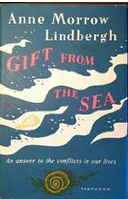
  • Gift from the sea

    Excerpt from Gift From the Sea by Anne Morrow Lindbergh.

    I began these pages for myself in order to think out my own particular pattern of living, my own individual balance of life, work and human relationships. And since I think best with a pencil in my hand, I started naturally to write. I had the feeling, when the thoughts first clarified on paper, that my experience was very different from other people’s. (Are we all under this illusion?) My situation had, in certain ways, more freedom than that of most people, and in certain other ways, much less. . . .

    And so gradually, these chapters, fed by conversations, arguments and revelations from men and women of all groups, became more than my individual story, until I decided in the end to give them back to the people who had shared and stimulated many of these thoughts. Here, then, with my warm feelings of gratitude and companionship for those working along the same lines, I return my gift from the sea.

    Your turn . . . write snippets of your story. Just write!

  • You can build a career as an author by playing to your strengths, following your true passion, going at your own pace and never shying away from your unique voice. — David Sedaris    Writers Digest Magazine, October 2013


  • One way to learn  how to write is to get a book in the genre you want to write in and use it like a text book.  With different colored highlighters, highlight dialogue in one color,  narration in another color, scenic descriptions in a third color. Notice how much dialogue there is compared to narration.  Write notes in the margins. Use sticky notes to show where one character’s story intersects with another character leading to the hookup later in the story. Note foreshadowing. Learn how successful authors craft their novels. And some day, someone learning to write might use your book as a textbook on how to write.