Write about something that seemed so wrong but turned out right.
 Photo by Breana Marie

Write about something that seemed so wrong but turned out right.
Photo by Breana Marie
Today’s writing prompt is inspired from the September 2014 issue of Writer’s Digest magazine.
“A man opens his mailbox to find an envelope containing a set of instructions.”
Set your time and write for 20 minutes. Set it aside for twenty minutes. Then read. Tweak, make a few changes, but not too many. The energy from that first and fast writing is usually spot-on.
Write a short story of 750 words or fewer based on this prompt and enter Writer’s Digest Contest #60.
Send your story using the online form at writersdigest.com/your-story-competition or send via email to yourstorycontest@fmedia.com (entries must be pasted directly into the body of the email; attachments will not be opened).

~ You see something you can’t live without, but you don’t have enough money to pay for it. What do you do?
~ You see a neighbor, alone, weeping. What do you do?
~ You see an acquaintance shoplift. What do you do?
~ You see two married acquaintances, without their spouses, heads and bodies close together, in a suggestive position. What do you do?
~ You are a young child and smile up at the grown-up whose hand you are holding but you don’t recognize the grown-up. What do you do?
Pick one and write for 20 minutes.
Note from Marlene: You can tweak prompts however you want. For example, with this prompt, the setting could be a deserted walkway near water, in a park, at a crowded Saturday market. You choose the setting and Just Write!

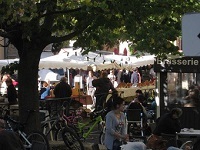

Photo by Sasha Oaks Photo by Jim C. March Photo by Kent Sorensen
Write about an article of clothing, shoes, or jewelry. . . something you are wearing right now.
 Photo by Breana Marie
“How’s the weather?”
It’s a question often asked. And sometimes we really want to know the answer.
Right now, Summer 2014, Northern California where I live, is experiencing a drought. Lawns are brown, cars are covered with layers of dust and dirt, flowers and plants are drooping. But I’m not complaining. We have plenty of water to drink and the public pool is a great place to cool off.
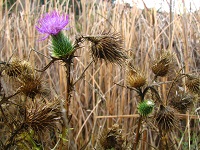 How’s the weather? We want to know!
Photo by Breana Marie
There are more how-to-write books than we have time to read. IF we tried, we would spend all our time reading about writing and not writing. But there are a few especially good how-to write books. Here are some of my favorites. What are your favorite writing books?
Dorothea Brande was an early proponent of freewriting. In her book Becoming a Writer (1934), she advises writers to sit and write for 30 minutes every morning, as fast as they can.
Peter Elbow advanced freewriting in his books Writing with Power and Writing Without Teachers (1975), and freewriting has been popularized by Julia Cameron through her books The Artist’s Way and The Right to Write.
A few more writing books:
Aronie, Nancy Slonim – Writing From the Heart
Baldwin, Christina – Storycatcher
Barrington, Judith – Writing the Memoir, From Truth to Art
Baty, Chris – No Plot? No Problem!
Bennet, Hal Zina – Write From The Heart
Clegg, Eileen M. – Claiming Your Creative Self
DeSalvo, Louise – Writing As A Way of Healing
Epel, Naomi – Writers Dreaming
George, Elizabeth – Write Away
Goldberg, Natalie: Living Color, Long Quiet Highway, Wild Mind, Writing Down the Bones, The Great Failure
Heffron, Jack – The Writer’s Idea Book
Kabat-Zinn, Jon – Wherever You Go, There You Are
Keene, Sam and Anne Valley-Fox – Your Mythic Journey
Kelton, Nancy Davidoff – Writing From Personal Experience
King, Stephen – On Writing
Lauber, Lynn – Listen to Me
Lamott, Anne – Bird by Bird
Lara, Adair – Naked, Drunk and Writing
Nelson, Sara – So Many Books, So Little Time
Rosenfeld, Jordan – Make a Scene
Saltzman, Joel – If You Can Talk, You Can Write
Schneider, Pat – Writing Alone And With Others
Smith, Michael C. and Suzanne Greenberg – Everyday Creative Writing
Ueland, Brenda – If You Want to Write
Walker, Christine – A Painter’s Garden
Walton, Todd & Toomay, Mindy – The Writer’s Path
Zimmerman, Susan – Writing to Heal The Soul
Just a few of my books on writing. Yes, I have two copies of Jordan’s Make A Scene: One for my personal use and one for lending.


The only sin writers can commit is not to write
— Eleanor Hyde
Eleanor Hyde, originally in the August 1976 issue of the Writer Magazine, reprinted in the August 2014 issue.
Note from Marlene: So, you are itching to write and need a jumpstart? Go to the prompts page of this blog for ideas.
Click here for more prompts and read what others have written. Scroll down and click on a plaque.
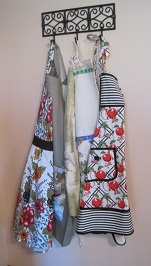 My grandmother put her apron on every morning right after she put on her house dress. She wore an apron every day, even to parties. She made all her clothes, including her aprons. She always chose a small flower design and used colorful seam binding for trim around the edges.
I also wear aprons, but only when cooking and eating. . . saves many an outfit from food stains.
Thank you, Kathy Myers, for the inspiration to hang my aprons in the kitchen.
Thank you, Pam Swanson, for emailing so many years ago, “The History of Aprons.”
THE HISTORY OF APRONS
The principal use of Grandma’s apron was to protect the dress underneath. Because she only had a few dresses, it was easier to wash aprons than dresses and they used less material, but along with that, it served as a potholder for removing hot pans from the oven.
It was wonderful for drying children’s tears.
From the chicken coop, the apron was used for carrying eggs, fussy chicks, and sometimes half-hatched eggs to be finished in the warming oven.
When company came, aprons were ideal hiding places for shy kids.
And when the weather was cold, Grandma wrapped her apron around her arms.
Those big old aprons wiped many a perspiring brow, bent over the hot wood stove.
Chips and kindling wood were brought into the kitchen in that apron.
From the garden, the apron carried all sorts of vegetables.
After the peas had been shelled, it carried out the hulls.
In the fall, the apron was used to bring in apples that had fallen from the trees.
When unexpected company drove up the road, it was surprising how much furniture that old apron could dust in a matter of seconds.
When dinner was ready, Grandma walked out onto the porch, waved her apron, and the men knew it was time to come in from the fields to eat.
It will be a long time before someone invents something that will replace that ‘old-time apron’ that served so many purposes, especially what many children and grandchildren received from the simple apron. . . Love!
Adapted from: The History of Aprons, which may have been originally from Grandma’s Apron.
Writing Prompt: Aprons
 Set your timer for 12-15 minutes and write.
Photo taken in Ireland by Jim C. March
