I Scream, You Scream

  • Memorable writing that sparks imagination. Lean in. Hear the writer’s voice on the page.

    I Scream, You Scream

    By Nona Smith

    It’s been well over a year since I’ve done any grocery shopping at Safeway. Early on in the pandemic, it was Harvest, our other local supermarket, who quickly adopted safety precautions: it made mask-wearing mandatory, limited the number of shoppers inside the store at any given time, provided handwashing stations outside, and offered free Latex gloves. Safeway was slow to adopt protective measures, making me feel unsafe in Safeway.

    Fast forward eighteen months, and I’m fully vaccinated and in need of a cake mix Harvest doesn’t carry. Being as health conscious as it is, the shelves in the baking section at Harvest are laden with organic, gluten-free, paleo, KETO, dairy-free cake mixes. There are only a handful of non-organic, full-on gluten, white sugar mixes on the very bottom shelf. I’m guessing their placement there is to give the consumer time to re-think their unhealthy choice while bending over to reach one of those boxes. So, I’m off to Safeway to find my cake mix.

    Of course, it’s there, nuzzled amongst dozens of others of its ilk, within easy reach. I pluck it from the shelf and decide to do the rest of my grocery shopping while I’m already in the store. I pull out my grocery list.

    When all the items are checked off, I crumple the list and stuff it into my purse. Then I go in search of the shortest check-out line, which––because shoppers are encouraged to stand on the six-feet-apart circles painted on the store floor––brings me half-way down the ice cream section of a freezer aisle. And, because I have nothing else to do while waiting for the line to move, I begin perusing the freezer cases and discover an ice cream trend. The highest end ice creams––Haagen-Dazs, Ben and Jerrys, Talienti––have adopted “layering” as a new marketing gimmick. Only pint cartons are offered this way: four layers of different textures and flavors. I’m imagining plunging my ice cream scoop far enough down into the container to reach all four layers at the same time. Nope, I determine, it can’t be done. One would need a spoon to get the effect the product promises. I suspect the idea really is, to sell more product by encouraging shoppers to have their very own pint to dip their very own spoon into. I can’t imagine this trend will last beyond the summer.

    The line moves, and I find myself in front of a section containing lesser-known brands, such as Fat Boy and Fat Boy Junior. I’m wondering what kind of market research led someone to name their product that when the line shifts again.

     Now I’m in the popsicle section and looking at a product that reminds me of the summers of my childhood. I can almost hear the tinkling notes of the white ice cream truck as it announces its tour through my neighborhood. And here it is in Safeway’s freezer: the Good Humor Creamsicle, orange popsicle on the outside, velvety vanilla ice cream on the inside. I’m tempted to put a package in my shopping cart. The only thing that stops me is knowing the Creamsicles would melt before I got out of the store.

    Another five minutes pass, and I’m now standing in that spot between the end of the aisle and the conveyer belt, leaving enough space for shoppers to pass through with their carts. An idea strikes me, and I reach into my purse for the crumpled shopping list and a pen. Smoothing out the list, I jot some notes about what I’ve just discovered. As a writer of personal essay, I know that anything––and everything––is fodder for a story. Why not ice cream?

    By the time I’m wheeling my cart out of the store, I’ve decided to make a stop at Harvest on my way home and do a little market research of my own.

    Standing in front of the ice cream freezer at Harvest, it’s just as I suspected. Yes, the high-end, four layered, products are there, but there’s no sign of Fat Boy or his son. Instead, there’s a product called Skinny Cow. Also, it appears there’s an equal amount of low fat, sugar-free, nonfat, nondairy ice creams made from soy, almond or coconut milk as those made from actual full-fat cow’s milk. The Rebel label promises “high fat/low carbs” for people on a KETO diet. There’s even an ice cream designed for kids who don’t like vegetables. It’s called Peekaboo and is made with “hidden veggies:” vanilla ice cream with zucchini, chocolate with cauliflower. Who knew? The freezer is filled with organic, health-conscious choices, seemingly designed to keep the Harvest shopper living a nutritious lifestyle.

    I tuck the note-filled grocery list back into my purse and head home. Maybe one day I’ll write a piece about ice cream.

    Nona Smith is the author of Stuffed: Emptying the Hoarders’ Nest and numerous other short stories published in various anthologies, including The Write Spot: Musings and Ravings From a Pandemic Year, journals and the St. Petersburg Times (now Tampa Bay Times.) Currently, she is writing a mystery about a woman named Emma whose dear friend goes missing. In her search for her friend, Emma finds herself. Nona writes personal essays and memoir pieces as well as fiction, always with an eye towards finding the humor in situations. She lives on the Mendocino coast with her husband Art and two mischievous cats.

    Stuffed: Emptying the Hoarders’ Nest and The Write Spot: Musings and Ravings From a Pandemic Year are available at Gallery Bookshop and on Amazon.

  • By Ken Delpit

    Individual voices are fascinating. They reflect uniqueness.They involve specific characteristics and abilities, both physical and mental. In tone and in lyric, they express specific perspectives and emotions. They can be soft; they can be harsh. They can be musical to some, grating to others. They can be up-lifting, but also down-putting. Voices may not define us completely, but they certainly represent us while the rest of us waits backstage.

    But voices rarely come just one to a customer. Multiple voices can reside in a single person. This is certainly true for writers. Each fictional character, partially invented and partially native, taps into its writer’s own voice box. Voices within propel writers’ fingers, and shape their stories.

    With few exceptions, it is also true that everyone has multiple voices, whether writer or not. Anyone who hides true feelings or conceals real intentions uses a voice convenient for the deceit. Anyone who senses that they could inflict emotional damage may give their real voice the hook, and push a kinder understudy out as stand-in.

    United voices can swell the heart. They project multiplied energy.They promote commonality. They express hope and desire in ways that are much greater than the sum of their individual parts. And in a good way, they reduce us. They reduce us to not-so-different beings, with both interests and purposes in common.

    Then, too, united voices can be daunting. When assembled spontaneously, they can give birth to future planned gatherings. When unanimous in pain, they can startle us into action. When joined in purpose, they can change societies. When unified in anger, they can erupt in revolution.

    Voices. Both calming and rallying. Both music and weapon. Take care of your voice, as you would a fine French horn. Be careful with it, as you would a loaded revolver. And, remember to let it be silent much of the time. Absence of voice can often be the most commanding, and most harmonious, voice in your repertoire.

    Hearing voices” is sometimes a sign of losing it. While that may well be true in his case, Ken Delpit clings to the notion that being fascinated by the many voices that surround and lie within us helps with his writing. Ken hopes to promote himself beyond his technical background (computers, mathematics) into credible and imaginative science-fiction novels.

    “Voices” was inspired by Baba Yetu, Prompt #583 on The Write Spot Blog.

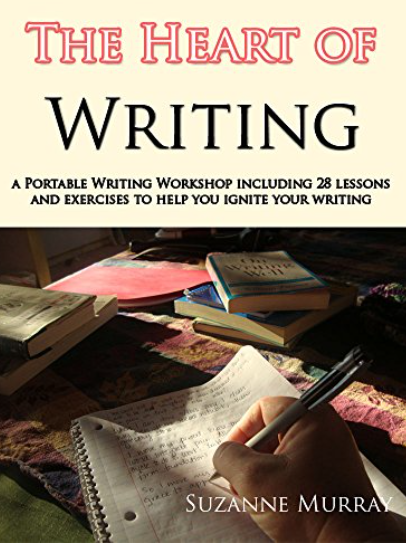
  • The Heart of Writing by Suzanne Murray, available at Amazon
     
    Guest Blogger Suzanne Murray encourages creativity by surrendering.  

    SURRENDER IS CRITICAL TO CREATIVITY

    We can’t force creativity. We know this intuitively. If we told a painter that we wanted a masterpiece by five o’clock tomorrow, they would look at us like we were crazy; that we clearly didn’t understand what being creative was all about.

    An important part of being creative is learning to surrender to the flow of the universe, allowing something greater than our everyday self to move through us. It’s not something we can figure out with our linear mind. Of course, if we want to paint we need to learn how to work with our chosen medium and studying the work of the masters can help.

    If we want to write it’s really valuable to read widely and deeply, to show up daily to put pen to paper (or fingers to keyboard) and perhaps take a workshop on the form we want to work with. Yet at the heart of being creative is letting go and allowing the ideas, the inspiration to move through us. This is where practice comes in.

    As Flannery O’Connor said of her writing experience, “I show up at my office everyday between 8 am and noon. I’m not sure that anything is going to happen but I want to be there if it does.”
    I recently met a young man in the park who had a set of watercolors laid out on a table and quickly produced a couple of small paintings that were quite lovely. We spoke of creativity and how so many people think you either have it or you don’t.

    “Yeah,” he said, “really it’s a muscle, you’ve got to use.”

    He went on to say “No matter how lousy I feel, if I do even a couple of little paintings I instantly feel better.”

    I feel the same way about writing, even if it’s just a page of free writing where I let the words flow out of the pen. Being creative feels good and lightens our mood because we become more present to the moment, quiet our chattering minds, and allow for the awareness of our heart and knowing to do the work.

    In the surrender we find ourselves in an expanded state of consciousness where we can do things we didn’t think we could. In whatever way creativity calls to you, make a habit of showing up to play with it. Let your self be guided by what excites you. Surrender to what brings you alive.

    Sending you blessings and the wish for creative flow, Suzanne.

    Suzanne Murray is a Creativity Coach, Life Coach, Writing Coach, and EFT practitioner.   She blogs at Creativity Goes Wild.  


  • By Kathleen Haynie

    Yes, it drives me nuts. They take an English word that has some nuanced meaning for them personally, and they use it to name some untouchable gadget they have invented. And then someone else makes the gadget anew and puts a new name on it. Then it becomes daily language usage.

    She was complaining that her boyfriend didn’t understand her feelings.

    “He doesn’t have enough bandwidth, I guess.”

    That word no longer belongs in Techieville.

    Complement with an “e” gets merged into compliment with an “I” because spell check doesn’t check it. Someone must think highly of me because I am always getting complimentary “one-month free” offers.

    My e-mail gadget is called a program, a file, or a client. My clients usually pay me for my services, but this one does a service for me for free!

    I went to copy some text on my computer to a CD disk. The boxes say rip, export, import, burn, copy. Which is which? Is it a webpage, a site, a platform, or what? 

    And how do I populate a digital screen? If I click “OK,” will it apply it?

    I put my computer desk in my new large bedroom. I had never slept with my laptop before, and did not know that computers, like spiders, are nocturnal creatures. In the middle of the nights, Microsoft updates my windows.

    I hate cleaning my windows. The updates update my task bar so the start icon won’t open and the sound icon doesn’t adjust the sound.

    The techie help support on the phone tells me to fix the problem by first opening the start icon.

    “Oh, that’s right. You can’t do that.”

    Help!

    Kathleen Haynie. This City Girl turned into a Sonoma County Horse Girl, and then retired from decades as a professional in health care. She is now acting out a latent inclination for the dramatic arts as a drama student and cast member of Off the Page Readers Theater. Surprisingly, the journey continues into the newly found delight discovered in written expression. Kathleen felt honored to have her work, What They Did to Alice, performed at the 6th Street Playhouse 2020 Women’s Festival. She has decided that dark chocolate is perfect with a full-bodied red wine.

  • Today’s Guest Blogger Lara Zielin:

          I often have the feeling I’m in trouble

          It’s this pervasive unease, like I’m doing something wrong.

          The problem is, I don’t know WHAT I’m doing wrong. Which means that if or when I get in trouble, it’s going to be a terrible surprise. 

          Because of this, I have my antennae up all day, scanning, looking, wondering what I could be doing that’s awful. I mind my P’s and Q’s and I try so hard to do everything right. I try to stay busy.

          I try to be so, so good. 

          But some part of me knows it won’t be enough. Trouble is still a-comin’. 

          Which means by the time I get to the end of the day, there is this exhausted part of me that is BEYOND READY to feel safe. To feel good enough. To feel comforted. 

          That part of me wants to eat ALL the carbs. And drink. And scroll Facebook. And numb, numb, numb. Because it’s painful out there, people. 

          This feeling has only gotten worse during the COVID-19 pandemic. 

          Without regular face-to-face check-ins with colleagues and friends, the gnawing unease that I’ve done something wrong only grows. My hankering for carbs only grows. My addiction to Netflix and my phone only grows. 

          That is, until I stop running and face the darkness. Until I open my arms to the fear and to the pain of thinking I’m not enough and just … sit with it. 

          I’ve been doing a LOT of writing around this lately. And I’m here for you if you want to do some writing around this, too.

          Instead of trying to run from the darkness, let’s invite it in. Let’s listen to it. And let’s meet it with love. 

          Because that’s the ONLY thing that’s going to help us feel better, feel lighter, and feel whole. If we run from the darkness, it will only continue to chase us. But if we embrace it, we can let it complete us. 
          To help us do just that, Lara is leading a free one-hour online group writing time on Thursday, April 23. 
          

    Note from Marlene: If you need ideas for relaxing and de-stressing, here ya go. You might already be doing some of these.

    I’m working on the next Write Spot book and will include these self-care tips and more!

    Creativity Coaching

    Alisha Wielfaert 

    Suzanne Murray

    Hypnotherapy

    Ted A. Moreno

    Inspiration

    Hands Free Mama – Rachel Macy Stafford

    Meditate

    Gaiam

    Headspace

    Insight Timer

    Mindful

    Movement

    Dance

    Ten minute Qi Gong

    Yoga

    And, of course. Write. Write what you know. Write what you want to know. Just write. If you need writing prompts, take a look at The Write Spot Blog.

  • Guest Blogger Alisha Wielfaert encourages us to work through the difficulties rather than be stuck in the mud.

    This excerpt is from her December 4, 2017 blog post, with her epiphany about her year of travel.

    The glowing orange moon rose over the cypress swamp as we drove home with tired limbs, hungry bellies and full hearts after a long day of kayaking. I had almost bowed out of this trip before it even started. 

    Maia called me on my last trip to DC before I left for Paris and said, “We’re camping at Carolina beach and taking a few of my students to kayak the three sisters swamp to visit some of the oldest cypress trees in the world.  Can you join us?”  

    Maia, full of energy and excitement, just isn’t someone you tell “no” even though I knew saying yes meant two days away from home after only 3 nights in my own bed. That’s how I found myself in a swamp in the middle of nowhere, NC somewhere near the coast.

    Sunlight streaked through the bare trees and flooded over us, floating on the water with two adventurous women. I reflected that this time last week I had been in Paris running next to the Seine then eating a bistro dinner. 

    It’s now December and I’m in a swamp with muddy, soaking wet shoes and socks because I just jumped out of a kayak to see, touch, and feel trees that are over 2500 years old. Older than Jesus.

    This self-proclaimed year of travel has been a wild ride. The backs of my eyes sting with tears I’m holding back as I realize that this year of travel adventures has ended.

    In addition to a touch of sadness, there is also extreme relief that these adventures are over because I’ve been spread thin more than when I was working a full-time job and running a yoga studio.  

    Reflecting on this through the cypress swamp I’m suddenly aware of the magnitude of everything I experienced in the last 12 months, and I’m emotional.  

    I’ve gained so much but also at a cost. I’m spent financially, relationships at home need tending, and I’m ready to give my new business my full attention.  

    I’m not ready to sum up the year just yet, there’s still too much to process and I need some space between the experience and writing about it.

    One of the biggest lessons of the year of the travel has been “too much of a good thing is still too much.”

    But if I had followed that lesson I would have said no to this camping trip and I would have got to rest at home, maybe even getting work done, but I never would have got to car camp at the ocean, and connect deeply with these men and women in the absence of many words while floating down a river and visiting 2500-year-old cypress trees in the middle of no-where.  

    While we were floating on the river, I realized that when you’re on the right path it feels like you’re being pulled and the current will carry you in the right direction.  Even if you do nothing you’ll at least be ever so slowly pulled in the right direction.  

    When you get off the right path you might find that you’ve landed on a sand bar alone and getting back into the current can be really difficult.

    When I worked in corporate America, I didn’t feel like I was moving. I was stuck in the mud.  

    I’ve had to claw and dig my way back to the current, to the right path, and now I feel like I’m being physically pulled in the right direction.  

    Looking back over this whole year I realize that as soon as I made my mind up to leave what didn’t serve me, I’ve been pulled in the right direction.  

    Frankly it’s not been a gentle process. It feels like I’ve been pulled through a class 5 rapids over the last 12 months and I’ve been hanging on for dear life trying to keep it together.

    But that’s a much better feeling than being stuck in the mud alone.  

    Meet Alisha Wielfaert

    I’m a leadership, life and creativity coach who specializes in working with women. I do this work because my purpose in life is to use my curiosity, empathy and listening skills to walk as a guide with seekers on paths towards clarity of purpose.  

    I’m the compass to point you towards your north to ensure you fully step into your own power.  

    I spent over a decade in corporate America in sales for an insurance company, a great company and a great career, but for someone else.

    I went about gathering tools, looking for the map and the compass to find my own north.

    I became a certified yoga instructor, taught yoga classes, opened a yoga studio and created a program to teach others how to share the gift of yoga.

    Yoga and the trainings I’ve received as a yoga teacher brought me closer to my calling, it gave me the map, but I wasn’t quite there.  

    After selling the yoga studio, I started leadership, life and creativity coaching.  

    For the first time in my life, I knew I could stop searching. I had my compass. This was the work I’d been put on this earth to do.  

    I coach individuals and groups, lead workshops to move you north of neutral, speak on topics to help others flourish, and lead retreats all over the world.  

    This work is my calling and it’s a gift to share it with you.  

    When we step into our power, we make the world a better place. Let’s shine our lights brightly together! 

  • Why write your story? So you can move on.
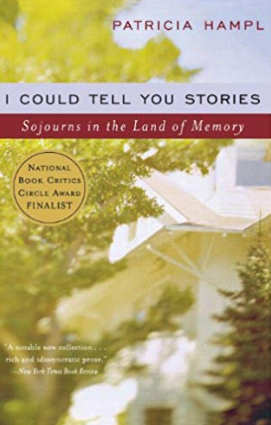
    Today’s post is inspired by Patricia Hampl’s book, “I Could Tell You Stories: Sojourn in the Land of Memory.”

    Tell your story so you can move on.

    “When a writer keeps things inside, it becomes a ball of tangled yarn. As each story is told, the ball becomes untangled. Writing from memory can help us to let go of those stories we tell over and over again. We may not even need to tell them again [after writing about them].”

    Note from Marlene: I think writing from memory can also be a type of self-help . . . a vehicle for transporting oneself back in time and getting in touch with what really happened.

    Patricia Hampl is an American memoirist, writer, lecturer, and educator. She teaches in the MFA program at the University of Minnesota at Minneapolis and is one of the founding members of the Loft Literary Center. Source: Wikipedia

    How to write without adding trauma

    Does your heart hurt?

    Writing about difficult times in your life by guest blogger Nancy Julien Kopp.

  • What do you call it when your creativity just seems to flow?

    Alison Luterman had an epiphany:

    I was singing in a little pop-up chorus this past month. It was a tricky classical piece, and the other women were all looking intently at their sheet music. I don’t really read music, so I ignored the paper and gazed at our teacher, trying to meld my brain with hers. Okay, I know this is going to sound woo-woo, but that night in chorus, watching the teacher’s hands on the keyboard, hearing her sing the parts, my body understood the music on a level my mind couldn’t.

    In Interplay we call this “ecstatic following” and we often do it as a group in dance. I remember being introduced to the concept and having an immediate suspicious reaction to it: “Ecstatic following– you mean you surrender your critical thinking? That’s how we end up becoming good Germans and supporting Fascism!” I’m very attached to my critical brain that helps me do crossword puzzles, solve murder mysteries, and participate in spirited debates.

    But when I go to sing or to dance or play theater improv games, if I worry too much about what I’m doing, or try to figure it out ahead of time with that same busy brain, I freeze up. I’ve seen some of my students try to scheme and strategize their writing and in the process block their own flow. The writing becomes stiff and wooden, and it feels like a burdensome task rather than an exploration.

    On the other hand, it’s good to know some technique. Thanks to an extremely patient musician husband, I can now find middle C on the keyboard and navigate around from there. I know what a scale is. I know the difference between a third and a fourth and a fifth, and on a very good day I can sing them. And all of that is helpful.

    So it’s not like Intuition Good, Technique Bad. It’s more like Left Foot and Right Foot, and then Left Foot and then Right Foot again. We need them both.

    In many ways I’m a left-brained nerd who loves crossword puzzles, dramatic structure and logical arguments. But that evening in chorus I remembered that my intuition is a resource that I can call on when I need it. I actually do this all the time with poetry, where the leaping and magic that the unconscious supplies are an essential part of the magic. I just didn’t realize that I could also do it with music which I think of as “hard” and something I’m not good at.

    We all have this ability to let the energy of doing the thing we love lead us, and that, combined with a deep abiding commitment to love and clarity and truth, can create great work. I just don’t know how to put Intuition on a syllabus or a lesson plan along with handling dialogue or story structure, or metaphors and similes and figurative language. But it is part of the package.


  • The Write Spot Blog is all about writing: Writing Prompts to inspire you; Just Write tidbits to motivate you; Quotes to let you know others are in the same boat as you; Places to Submit to get your work out there; Book Reviews to share authors’ work; Guest Posts for all kinds of writing-related things.

    Today’s Guest Blog Post by Suzanne Murray talks about increasing your creativity by relaxing. Sounds easy, doesn’t it? But what about cortisol, adrenaline, and epigenetics? Factor those in, and it becomes apparent that relaxation isn’t as easy as drifting in a hammock.

    Fortunately, Suzanne Murray offers strategies to help us learn to relax. 

    HOW CREATIVITY CAN HELP US RELAX

    We all know that relaxation makes us and our bodies feel good whereas stress causes us to tense up and feel less that optimum. New scientific research shows just how important relaxing our bodies and minds is.

    The emerging science of epigenetics shows that our genetic expression is not permanently fixed at birth, but actually evolves as we grow and learn. Environmental factors including nutrition, stress and our emotional responses can affect how our genes express themselves without changing the basic blueprint of our DNA, the genetic material in our cells.

    When we are stressed our genes produce hormones associated with fight or flight like adrenalin and cortisol that are associated with aging and making us more susceptible to disease. When we are relaxed and feeling good our genes produce chemistry that boosts our immune system and helps with cellular repair and growth. 

    A study looking at mindfulness practices like meditation, yoga, breath work, and other relaxation techniques, showed that we can actually “turn on” disease-preventing genes and “turn-off” disease-causing genes through relaxing. Research on the energy psychology modality EFT (Emotional Freedom Techniques), an easy to use self-help strategy that combines western psychology with Chinese acupressure, found that an hour session of EFT lowered cortisol levels by 24 percent.

    I’d like to add creativity to ways we can relax as well as develop more of our potential.

    Creativity is really a form of mindfulness since it puts us in the flow of the moment and feels good. Adult coloring books have been shown to reduce stress. I like doodling or free writing where you just let the words flow out of the pen with no thought to what you are writing.

    Bringing play to whatever process you are working with and letting go of attachment to outcome is important.

    Stress so often stems from the fact that our mind has leapt ahead with worry about the future or is chewing over something that happened in the past. When we do things that bring us into the moment we naturally relax.

    Find what works for you. Play with it and see if you feel better.

    Suzanne Murray is a gifted creativity and writing coach, soul-based life coach, writer, poet, EFT practitioner and intuitive healer committed to empowering others to find the freedom to ignite their creative fire, unleash their imagination and engage their creative expression in every area of their lives. She works with simple, powerful techniques to help clear whatever gets in the way and creates a safe and sacred space for your creative and soulful life to blossom. She provides an experience of the joy and beauty that comes from embracing your gifts and expressing them in the world. With a lifelong connection to the natural world, she enjoys sharing the grace and wonder that Nature can bring to your life and creativity

     Writing and Creativity in Nature
    One Day Workshop Point Reyes CA
    April 22, 2017, 10 am to 4 pm

    Spending time in nature is good for our health, enhances our creative capacities and increases our general sense of wellbeing. It can help us enter the flow. Join me for this one day workshop where we will work with our creativity in the beauty of nature.

    EFT (Emotional Freedom Techniques)

    I’ve been working with EFT in new ways that allow us to laser in on the issue and shift it at the core. We often make significant shifts in a single session. Sessions are available by phone and Skype


    Original posted on Suzanne’s April 2, 2017 Blog


  • Guest Blogger Suzanne Murray writes about how surrender can help creativity:

    We can’t force creativity. We know this intuitively. If we told a painter that we wanted a masterpiece by five o’clock tomorrow, he or she would look at us like we were crazy, that we clearly didn’t understand what being creative was all about.

     An important part of being creative is learning to surrender to the flow of the universe, allowing something greater than our everyday self to move through us. It’s not something we can figure out with our linear mind.

    Of course, if we want to paint we need to learn how to work with our chosen medium and studying the work of the masters can help. If we want to write it’s really valuable to read widely and deeply, to show up daily to put pen to paper and perhaps take a workshop on form we want to work with.

    Yet at the heart of being creative is letting go and allowing the ideas, the inspiration to move through us. This is where practice comes in. As Flannery O’Connor said of her writing experience, “I show up at my office everyday between 8 am and noon. I’m not sure that anything is going to happen but I want to be there if it does.” 

    I recently sat next to a young man in Starbucks who had a set of watercolors laid out and quickly produced a couple of small paintings that were quite lovely. We spoke of creativity and how so many people think you either have it or you don’t. “Yeah,” he said, “really it’s a muscle, you’ve got to use.” He went on to say “No matter how lousy I feel, if I do even a couple of little paintings I instantly feel better 

    I feel the same way about writing, even if it’s just a page of free writing where I just let the words flow out of the pen. Being creative feels good and lightens our mood because we become more present to the moment, quiet our chattering minds, and allow for the awareness of our heart and knowing to do the work. In the surrender we find ourselves in an expanded state of consciousness were we can do things we didn’t think we could.

    Originally posted on Suzanne Murray’s Blog,  March 2017

    Suzanne Murray is a gifted creativity and writing coach, soul-based life coach, writer, poet, EFT practitioner and intuitive healer committed to empowering others to find the freedom to ignite their creative fire, unleash their imagination and engage their creative expression in every area of their lives. She works with simple, powerful techniques to help clear whatever gets in the way and creates a safe and sacred space for your creative and soulful life to blossom. She provides an experience of the joy and beauty that comes from embracing your gifts and expressing them in the world. With a lifelong connection to the natural world, she enjoys sharing the grace and wonder that Nature can bring to your life and creativity.