

Tips To Unlock The Book Only You Can Write

  • Guest Blogger Jenn Gott writes about 3 Inspiring Ways to Unlock the Book Inside You.

    Does this sound familiar: You’ve always been drawn to writing and have a mind brimming with ideas. You’ve always loved the idea of holding a book you have written — but somehow, despite all your best intentions and New Year’s Resolutions, it just hasn’t happened.

    Or maybe you’re a writer who has started a thousand writing projects, only to abandon them all within a few pages. Perhaps you’re not even sure if you want to be a writer, but you’ve always wanted to write a children’s book for your kids.

    Maybe you’re a poet, or a copywriter, or a journalist, and there’s a book you know you could write, if you just find the right words inside you.

    Maybe, maybe, maybe. One day.

    The trouble with “one day” is that it doesn’t exist — each day, there’s only today. Which is why I’m bringing you the three best practices that I’ve found to unlock and supercharge creativity. It doesn’t matter whether you’re a beginner who has always wanted to tell your story, or a seasoned pro who’s gotten mired in delays, worries, and self-doubt. Either way, these habits will have words flowing in no time.

    1. Find your community

    From National Novel Writing Month (NaNoWriMo) participants to your local writer’s group to authortube, it’s important to find your people wherever you can. Support is everything on your journey toward finishing a book, and it will inspire you more than anything else. To start, identify what kind of groups appeal most to you. Would you prefer to interact online,where you can hang out in your pajamas and reply at your leisure? Or would getting out of the house and seeing people face-to-face reinvigorate you? Are you interested in a classroom setting, a critique circle, or just some supportive friends who will provide lively discussion? Do you want to learn from people who are much more experienced than you, or strive together with peers at your skill level?

    Don’t feel you need to limit yourself to only one group. There’s nothing to keep you from making writer-friends on Twitter, and in person at bookish events, and through workshops. In fact, the more avenues you explore, the more likely you’ll find “your people.” Consider going to conferences, book signings, and events at your local library.

    Your community doesn’t need to be all writers. While it’s important to know some — to understand exactly what you’re going through, and bounce ideas off each other — a supportive and understanding friend or partner can go a long way. As you seek out connections, make sure to you surround yourself with people who believe in you. Remember, helpful and constructive criticism is good — how else can you learn the skills you’ll need to edit your book to perfection? But ragging on you and your work is toxic for everyone involved.

    2. Fill your creative well

    Sometimes the reason we’re not writing is simply that we’re emotionally tapped out. There are many factors that can cause creativity to dry up — everything from stress to poor mental health, to overwork, fatigue or illness, and creative burnout. And while it may feel silly to take time off to recharge if you haven’t been writing lately, sometimes that’s exactly what you need to do. Think of it like an arrow: pulling back first, in order to shoot forward.

    It’s important to make sure you’re recharging the right way, though. Scrolling through social media may be satisfying, but is it really going to inspire you to sit down at your laptop and write? Or would that time be better spent going for a walk, seeing a play, or reading an exquisitely written book?

    If you’re having trouble writing, take a minute to sit down and make a list of the things that energize you — physically, mentally, and creatively. Maybe plays aren’t your thing, but poetry is. Maybe a walk exhausts you, but yoga centers your mind. It really doesn’t matter what it is (truth be told, sometimes a movie or a video game inspires me). You just need to walk away from it refreshed, rejuvenated, and ready to tackle your big creative project.

    However, be careful not to let this turn into further procrastination. Remember, the point of these activities is to inspire you, not consume you. Always take a few minutes afterward to reflect on which parts of the experience spoke to you, and how you might use similar themes, moods, or ideas and blend them into your own work — or which mistakes you’ll want to avoid.

    3. Create your own writing retreat.

    Of course, we’d all love to go to a week-long retreat at a fancy cabin in the woods, but for many of us that simply isn’t an option. Luckily, there are ways to recreate the retreat feeling without venturing far from home or taking a lot of time out of your busy schedule.

    First, start by identifying any and all locations near you that might offer some peace and solitude. This can be as simple as locking your bedroom door, or as elaborate as a nice hotel nearby where you can book a room for a night or a weekend. Coffee shops, parks, or trains, and subways can do the trick, especially with a good pair of headphones! The point is to find someplace where you can block out thoughts of the outside world, including all your daily responsibilities. If you’re lucky enough to have a home office or a “room of one’s own,” try to find someplace else for your retreat — someplace you don’t work in every day.

    Next, consider what approach would best make that space feel more “writerly.” Would music help you, and if so, what kind? Would you feel more soothed with a soft blanket, a hot water bottle, or a big glass of wine? Candles, fairy lights, or other mood lighting can also help set the stage of your imagination. Remember, the point of this is to feel pampered, so don’t skimp on the creature comforts.

    Once you’ve identified where you’re going to take your “retreat” and how you’re going to cozy it up, the final step will be scheduling. This is, admittedly, the hardest part of your task, but with a bit of effort you can make it work. Try to block out a whole day, although even a few hours will be a huge boost.

    For magically productive people, just showing up might be enough to get the words flowing. For the rest of us, it might take a little more work, and a few handy tips and tricks. If you find yourself frozen at the prospect of getting started, consider freewriting as a warm up.

    Still unsure what to write about? Writing prompts might just be the kick your brain needs.

    Whatever you do, don’t stress out if your first “retreat” isn’t as fruitful as you’d imagined. Any progress is still progress, and the more often you repeat the writing habit — in any environment— the faster your creativity will kick into gear.

    Above all, remember: only you can tell your story. So, what are you waiting for? Get out there and tell your story. Today.


    Jenn Gott is an indie author and a writer with Reedsy, so she basically spends all her time either writing books, or helping people learn how to write books. She firmly believes there is no writing skill you cannot learn with practice and the right guidance. When she’s not working, she enjoys keeping up with the latest superhero movies, reading, and swimming.
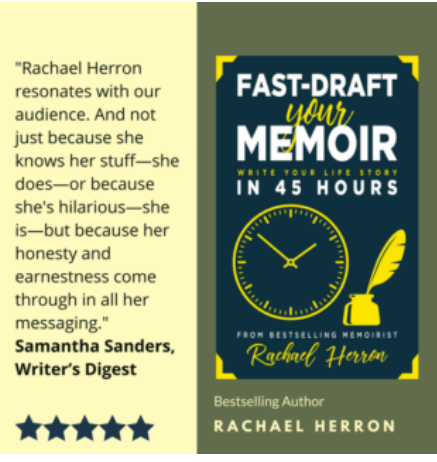
  • Today’s Guest Blogger is Rachael Herron, one of my favorite writers. Read one of her books and you’ll know why. More on that later.

    For now, you get to sneak a peek into how she gives priority to the problem, rather than to the answer.

    Hi Writers,

    I spent yesterday morning in the tub, thinking about writing. It wasn’t procrastination, I promise. It was actually the most delicious thing ever.

    Usually, I get up and have coffee and do yoga and write in my journal, and then I jump into work. I work all morning on writing and revision, and I use my afternoons to answer email, record my podcasts, teach, and coach.

    Yesterday, my “writing” took the form of thinking.

    And I was cold.

    So I got in the tub at ten in the morning.

    I lit a candle to help me think, for something to stare at. I brought in with me a notepad and a pencil (I love the Aquanotes waterproof writing pad) but I turned to my phone instead, making voice memos in Evernote. I didn’t look at Twitter or Facebook, I just thought. I allowed myself to go down deep internet rabbit holes (when was the last orphanage in Venice closed? What’s a debilitating disease that requires care but doesn’t immediately kill?).

    I paddled. I splashed.

    It was, pretty much, heaven.

    And it was part of the job.

    I want right now to remind you of that. If you’re stuck in the middle of something, PLAY.

    Write out all the frustrating questions you can’t figure out answers to and get in the bath with them. No bath? Go (alone!) to a hot tub place, bonus points if it’s outside and you can see the sky. Or go to the beach or lake, bundling up if it’s cold. Get your favorite splurge-y coffee drink and drive to the best view you can find. Tilt the seat back and just think.

    Meander in your mind. Wander around. If the answer stumps you, go in a different direction.

    Give priority to the problem, and not to the answer. I felt that yesterday — I kept trying to latch on to the “right” answer until I realized there wasn’t one, not really. I can write a book about anything. Poking around and trying to grab the “correct” book idea wasn’t going to work, but letting myself play with the problem did work.

    What you’re doing when you do this is priming your mind to keep working on it in the background, while you go to work or feed the kids or sleep at night. Your brain will keep working on this, the more you play with the ideas, and then one afternoon while you’re searching for the Tom’s of Maine that doesn’t suck (spearmint), the answer will drop into your mind. A flash of inspiration, yes, but it’s a flash that you set yourself up for.

    Remember to play. Writing is hard work, yes. I spend a lot of time acknowledging that it’s often a painful thing to push yourself to do. So if it’s been awfully hard lately, or if you just haven’t been getting anything done, give yourself permission to play.

    See what happens.

    Onward! Rachael

    Rachael’s Bio includes my favorites of her books.

    Rachael Herron is the bestselling author of the novels The Ones Who Matter Most (named a 2016 Editor’s Pick by Library Journal), Splinters of Light and Pack Up the Moon (all from Penguin), the Darling Bay and the Cypress Hollow series, and the memoir, A Life in Stitches (Chronicle).

    Rachael’s latest book, Fast-Draft Your Memoir: Write Your Life Story in 45 Hours, is about writing quickly while still creating a compelling narrative arc out of the story only YOU can tell.


    She received her MFA in writing from Mills College, Oakland and she teaches writing in the extension programs at both UC Berkeley and Stanford. She’s proud to be a New Zealander as well as a US citizen, though her Kiwi accent only comes out when she’s very tired. She’s honored to be a member of the NaNoWriMo Writers Board. She is currently a Writer in Residence at Mills College.

  • There are more how-to-write books than we have time to read. IF we tried, we would spend all our time reading about writing and not writing. But there are a few especially good how-to write books. Here are some of my favorites. What are your favorite writing books?

    Dorothea Brande was an early proponent of freewriting. In her book Becoming a Writer (1934), she advises writers to sit and write for 30 minutes every morning, as fast as they can.

    Peter Elbow advanced freewriting in his books Writing with Power and Writing Without Teachers (1975), and freewriting has been popularized by Julia Cameron through her books The Artist’s Way and The Right to Write.

    A few more writing books:

    Aronie, Nancy Slonim – Writing From the Heart

    Baldwin, Christina – Storycatcher

    Barrington, Judith – Writing the Memoir, From Truth to Art

    Baty, Chris – No Plot? No Problem!

    Bennet, Hal Zina – Write From The Heart

    Clegg, Eileen M. – Claiming Your Creative Self

    DeSalvo, Louise – Writing As A Way of Healing

    Epel, Naomi – Writers Dreaming

    George, Elizabeth – Write Away

    Goldberg, Natalie:   Living Color, Long Quiet Highway, Wild Mind, Writing Down the Bones, The Great Failure

    Heffron, Jack – The Writer’s Idea Book

    Kabat-Zinn, Jon – Wherever You Go, There You Are

    Keene, Sam and Anne Valley-Fox – Your Mythic Journey

    Kelton, Nancy Davidoff – Writing From Personal Experience

    King, Stephen – On Writing

    Lauber, Lynn – Listen to Me

    Lamott, Anne – Bird by Bird

    Lara, Adair – Naked, Drunk and Writing

    Nelson, Sara – So Many Books, So Little Time

    Rosenfeld, Jordan – Make a Scene

    Saltzman, Joel – If You Can Talk, You Can Write

    Schneider, Pat – Writing Alone And With Others

    Smith, Michael C. and Suzanne Greenberg – Everyday Creative Writing

    Ueland, Brenda – If You Want to Write

    Walker, Christine – A Painter’s Garden

    Walton, Todd & Toomay, Mindy – The Writer’s Path

    Zimmerman, Susan – Writing to Heal The Soul

    Just a few of my books on writing. Yes, I have two copies of Jordan’s Make A Scene: One for my personal use and one for lending.

                               writing books 1                                writing books 2

  • Guest Blogger Bella Andre shares what it takes to get writing.

    In the workshops I give to writers, I talk a lot about blocking out the white noise (email, Facebook, phone calls, prolonged internet searches for information you don’t really need to know to write your first draft, etc.) and putting on blinders so you can really give your focus to your book. This advice is a lesson I personally relearn with every single book I write.

    That’s the quick and pretty version, but if you pull back the glossy cover, the past 30 months actually look like this:

    * Decide to start my new book.

    * Do everything but start the book.

    * Make more big plans to start the book, for real this time.

    * Freak out about not starting the book.

    * Tell myself that tackling the non-writing items on my enormous to-do list is important, necessary work, so really, how could I start the book yet?

    * Tick through non-writing items on my to-do list and get crankier by the day.

    * Force myself to sit down with my laptop and stare at the blank page and not get up until I’ve written at least 1,000 words.

    * Finally realize (yet again!) that the number-one thing to help both my career and my peace of mind is sitting down and writing. Every single day. From one book to the next.

    Today’s start of Sullivan #12 was no exception. I went through every one of the above steps during the past two weeks until I simply couldn’t stand it anymore. When I woke up this morning, I decided the to-do list could wait. Answering emails could wait. A walk could wait. Eating could wait.

    But the book could not.

    I truly believe that no matter where you are in your writing career, the book is always the most important thing. For a new writer, finishing your first book will likely require great focus and determination. All you want is to finally get to “The End.” But once your book is out in reader’s hands, the most important thing will always be your next book. I’ve seen again and again, in both my own career and others, that the surefire way to create ongoing success is to write the next book. And the one after that. And the one after that.

    Once I finally push myself to start a new book, I always find that’s when the focus finally comes. Fortunately, day by day as I sink deeper into the manuscript, it becomes far easier to block out that white noise and keep focus on the writing.

    Happy writing! Bella Andre.

    Visit Bella’s Facebook Fan Page.

    This “Pep Talk” originally appeared on National Novel Writing Month’s website, nanowrimo.org

    Having sold more than 2.5 million self-published books, New York Times and USA Today bestselling author Bella Andre’s novels have appeared on Top 5 lists at Amazon, Apple, Barnes & Noble and Kobo. After signing a groundbreaking 7-figure print-only deal with Harlequin MIRA, Bella’s Sullivan series are being released in paperback in a major global English language launch in the US, Canada, the UK, and Australia in continuous back-to-back releases from June 2013 through April 2014. Known for “sensual, empowered stories enveloped in heady romance” (Publishers Weekly), her books have been Cosmopolitan Magazine “Red Hot Reads” twice and have been translated into nine languages, and her Sullivan books are already Top 20 bestsellers in Brazil. Winner of the Award of Excellence, The Washington Post has called her “One of the top digital writers in America” and she has been featured by NPR, USA Today, Forbes, The Wall Street Journal, and most recently in TIME Magazine. She has given keynote speeches at publishing conferences from Copenhagen to Berlin to San Francisco, including a standing-room-only keynote at Book Expo America on her self-publishing success.


  • B Lynn Goodwin

    What Would You Do With a Goal and a Deadline?

    Guest Blogger:

    NaNoWriMo, www.nanowrimo.org, invites you to draft a 50,000 word novel in one month. I’m doing it for the second time, and I’m going for higher word totals than the 1667 suggested daily allotment. I just want this first draft out of my head. I want material to work with.

    Not a fiction writer? You can still achieve a 30-day goal with memoir, biography, or any other form of non-fiction thanks to author and writing coach Nina Amir’s WINFIN, http://writenonfictioninnovember.com/about-2/. WINFIN (Write Nonfiction in November) is “an annual challenge to create a work of nonfiction in 30 days.”

    The rules are simple: Decide what you’re going to complete and go for it. You can create “an article, an essay, a book, a book proposal, a white paper, or a manifesto” The program “operates on an honor system…no word counts logged in here. It’s a personal challenge, not a contest.” Simply describe the nature of your project and come back at the end of the month and say how you did.

    Working on a memoir? Guest blogger Dennis Ledoux provides a day- by-day guide that conveniently runs for 30 days: http://writenonfictionnow.com/how-to-write-your-memoir-in-30-days-2/. November 1 is an arbitrary start date, of course. Pick your own starting day, but pick it soon, and commit yourself to working on the project for the next 30 days. Need weekends off? Commit yourself to working for the next 40 days.

    The author of the bestselling How to Blog a Book: How to Write, Publish and Promote Your Work One Post at a Time (Writer’s Digest Books), Nina Amir is a nonfiction editor, proposal consultant, author and book coach, and blog-to-book coach with more than 34 years of experience in the publishing field.

    The other day I thought about starting a National Journaling Month. Journaling primes the pump and greases the wheels. It gets writers started. It helps them dig deeper into their thoughts and find multi-dimensional truths. Participants in the National Journaling Month could record daily events, track their eating or exercising or arguing behaviors, analyze and resolve a decision about school or work or parenting, derail a negative thought pattern, or celebrate the joys of life. Journaling is an outstanding preparation for any writing project. It helps you figure out what you really want to say.

    Journaling for 30 days can achieve its own set of miracles, just like completing a non-fiction project or even writing a 50,000-word novel. Set a goal. Then share it with a community of writers. You’ll never know what you can accomplish if you dream of writing instead of actually doing it.

    B. Lynn Goodwin is the owner of Writer Advice, www.writeradvice.com, and the author of You Want Me to Do WHAT? Journaling for Caregivers, available on Amazon. Her stories and articles have been published in Voices of Caregivers; Hip Mama; the Oakland Tribune; the Contra Costa Times; the Danville Weekly; Staying Sane When You’re Dieting; Small Press Review; Dramatics Magazine; Career; We Care; Thickjam.com, Friction Literary Journal, and The Sun.

    A former teacher, she conducts workshops and writes reviews for Story Circle Network and InspireMeToday. She’s working on a YA novel and brainstorming a memoir.

  • Are you the type of person who needs to clear your desk before getting down to the business of writing?  Me, too. I have to pay the bills, sort, organize, stack things on my desk.  Satisfied, but not ready to get to writing, I look around. Oh, I really need to do the laundry, clean the bathroom, clean the floor, check the refrigerator, look outside, get a drink of water. Sometimes it seems I’ll do everything except write.

    One year I participated in NaNoWriMo for the month of November. I loved it. This year I’m going to participate in Write Nonfiction in November (WNFIN), founded by Nina Amir. But I know I’ll only be successful if I plan ahead.

    Here are Twelve Steps to get to that writing we so want to do.

    1. For the next two weeks, get caught up. Get organized, file those pieces of paper that clutter your desk, your counter, your life.

    2. For the next two weeks, spend extra time crossing things off your actual or mental to-do list. Whatever you’ve been putting off doing. . . do it now.

    3. Plan ahead. What do you usually do in November that you can do now? Put all the Thanksgiving and holiday items in a box (tablecloth, napkins, decorations, plates, etc).

    4. Get a box ready for all the incoming stuff. . . mail and paperwork that can wait until December.

    5. Get another box for important, don’t-want-to-forget items. As things arrive, put them here. Then, once a week in November, take care of business. . . spend as little time as possible. Just get this stuff done so you can get back to writing.

    6. Plan snacks. Make a list of perishable snacks you want to have on hand, so you don’t have to think when the time comes to purchase the snacks. Just take your list to the store. Then get back to writing.

    7. Plan meals. Same as above. Keep meals really easy. Soup and sandwiches. Simple salads.

    8. Purchase whatever you can now for your food needs/wants/cravings. Yes, you will have cravings. Plan for them. Don’t agonize over this. Keep your mind deep in the Land of Writing. But you will need motivation to keep going, not a reason to sneak off for ice cream.  Fill freezer, pantry and cupboards with food stuff you know you will want.

    9. Tell your friends and family whatever you want. . . you have a contagious disease, you have laryngitis, you’re on deadline (you are) . . . but you aren’t accessible to babysit, carpool, lend an ear or a shoulder. This is Your Time to write.

    10. Have everything lined up that you will need . . . paper, pens, ink cartridges, list of writing prompts as daily warm-ups, ashtray (just kidding, unless you really do smoke), water, snacks.

    11.  Turn your phone off, do not look at Facebook until the end of the day, do not get distracted with tweeting, twittering, looking, sneaking, freaking, or any of the many things that will tempt you to distraction.

    12.  Set up your good luck charms, talismans, touchstones, candles, lucky rabbit’s foot . . . whatever it takes to remind you . . . for the month of November. . . You Are A Writer.

    Write that on a post-it note. Post it prominently. Look at it. Remember it. Believe it. You Are A Writer.

    What helps you to keep focused on your writing? What steps would you add to being a successful writer?


  • Location, or place as a character

    It is Sunday in Hamburg. Six o’clock in the morning and everything is quiet. Most people are sleeping peacefully in their beds, but not me. I’ve been awake all night. Waiting for this special moment. I feel tired but push on: there is nothing better than the beauty of a new dawn and the breeze of freedom it holds. Soon, I will go to the one place where people who lived through the night can meet those who are first to welcome the morning.

    Entering downtown Montrealis like stepping through a time machine. The old port brings you straight to the 1600s: where architectural elegance usurped function, and everything was made of stone. And these stones have stories to tell—showing the stains of floodwaters from as far back as 1642.

    New York: The City That Never Sleeps. It’s a common phrase, but it means a lot more than last calls at 4 a.m. and a 24-hour subway system. This town doesn’t run on one schedule, it runs on over 8 million.

    Bodegas, hot dog carts and $1 pizza places line the streets of Midtown Manhattan and the Village, catering to this continual flux of pedestrian traffic. Trains full of 9-to-5ers pour out of Grand Central Station, giving way to tourists, then pre-curtain-call diners, then club-goers and night shift workers, on to the late-night partiers and night owls, until, as dawn breaks, early-shift workers and audition-goers pass through, re-starting the cycle all over again.

    Your Turn: Write about a city.


    photo by Colby Drake

    Prompt #8

    Write about a city . . . where you live now, or used to live, or have visited, or from your imagination.  Here are examples from the NaNoWriMo Blog. 

  • Develop Character . . .

    I’ve been thinking about characters lately. If you are going to participate in NaNoWriMo, how about doing some freewrites now, set the stage for the “real” writing in November. And if you aren’t part of NaNoWriMo . . . today’s prompt will work for you, also. If you have a fictional character you work with, put your character in a setting he or she wouldn’t normally be in. For example, put your conservative character in an improv situation where he/she has to rap. Have your wild character volunteer to help with bingo in an assisted facility.


    Prompt #4

    See what your character does in unusual situations.