Are You Starving Your Soul?

  • An honest evaluation by Guest Blogger Nina Amir:

    I had to get really honest with myself. And then I had to get honest with others . . .

    I have been unhappy. I have not been successful. I have given away my power. I have not followed my own path. I have lived up to other people’s expectations.

    I have not lived the life I wanted to live or done the work that is my purpose in this lifetime—my life’s work.

    And something had to change. I had to change. My life had to change.

    I’d been starving my soul.

    Now, I am feeding it. I am creating, day by day, a life that feeds my soul.

    And every day I’m a bit happier and fulfilled.

    I’m starting to recognize myself again.

    I’m making little changes that put me back on the path I want to walk.

    People have asked me: “Why are you offering a program about personal and spiritual growth? You are an expert on writing, publishing, and blogging.”

    Well . . . I’m also a Certified High Performance Coach—which makes me an expert in personal growth.

    And I’ve been studying and writing about spirituality and metaphysics for years. And I’m a Law of Attraction (LOA) coach and a minister. I guess that makes me an expert in spiritual growth.

    And . . . more than any of the credentials, writing and coaching about personal and spiritual growth makes my heart and soul sing. It’s my passion. It inspires me.

    And, if I am going to live a life—create a life—that feeds my soul, I have to focus on my life’s work. I have to write and speak and coach about personal and spiritual growth.

    Watch the changes happening . . . to my website, my offerings, me . . .

    And ask yourself: Is your life starving your soul or feeding it?

    In this crazy world . . . at this crazy time . . . start living a life that feeds your soul. None of us know what will happen to us tomorrow.

    You are a creator. You are meant for more. Create a life that feeds your soul.

    If you want to know how to do that, go to www.ninaamir.com/ICC.

    Nina Amir is known as the Inspiration to Creation Coach because she helps her clients combine their passion and purpose so they Achieve More Inspired Results. It’s Nina’s mission to help people step into the best version of themselves, fulfill their purpose, and achieve their potential as they create fully lived lives.

    Nina Amir’s Books
    Nina is a hybrid author who has self-published 18 books. Her traditionally published books include How to Blog a Book, The Author Training Manual and Creative Visualization for Writers.

    Nina’s Blog

  • Guest blogger Jared Gulian wrote a fun story about his dream of being published. I love publishing stories that are inspiring and enjoy stories that take place in San Francisco, my home town.

    “I’m giving up,” I said. “‘Moon over Martinborough’ is never going to be a book.”

    Ever since I’d started this blog I’d wanted to turn it into a book, but I was losing hope.

    “Maybe you shouldn’t give up just yet,” Uncle Oscar replied.

    Uncle Oscar was here on his annual visit from New York, and we were sitting at the Gamekeeper, the restaurant at Alana Estate vineyard just down the road. CJ and I were having lunch with Uncle Oscar and our friends Leelee and the Wolf.

    “Uncle Oscar’s right,” Leelee said. “Don’t give up.

    Although the blog had gained some recognition, after 3 years of hard slog I still felt no closer to my book goal. It didn’t matter that I already had a first draft of the book manuscript put together, or that my stories were appearing regularly in Wairarapa Lifestyle Magazine. I was ready to throw my hands in the air.

    “Why don’t you write a book proposal and send it to publishers?” Leelee said. “I have a great book which tells you how to write a book proposal. You can borrow it.”

    CJ and the Wolf joined in, and the group’s gentle cajoling continued until I finally agreed to write a proper book proposal.

    Writing a book proposal

    Leelee’s copy of ‘How to get published and make a lot of money!’ by Susan Page was my guide. The title is a bit embarrassing, but it has a very good chapter on how to write a book proposal. It explains how to write sections on the author, the audience, the marketing plan, analysis of the ‘competition’, and chapter-by-chapter outline.

    I spent almost two months working on that proposal. I honed and crafted and redrafted. On 16 May 2012 I sent that proposal – printed handsomely and filled with gorgeous photographs – to four publishers. I figured it would sit for months in their ‘slush piles’ of unsolicited material, and I’d be lucky if I ever got a response.

    Well, blow me down if I didn’t get a response less than two weeks later. It was from Nicola Legat, Publishing Director at Random House New Zealand. She said, “Many thanks for sending in your overview of Moon Over Martinborough. I am impressed by and grateful for the very detailed analysis it contains. I’d very much like to see the first draft.”

    Huh? Was this possible? I quickly sent her my manuscript.

    HourglassWaiting for the decision

    Then the painful waiting began. Each day was sheer torture. What was Nicola thinking? Would she hate my manuscript? Would she love it?

    After a week that felt like an eternity, Nicola emailed saying, “Just a quick note to say that I am halfway though, and I am loving it! I’ll be back to you next week.”

    Yeah! But it wasn’t final yet. Maybe the second half of my manuscript was horrible. Maybe she would change her mind.

    Finally Nicola’s response came. “I’ve now finished my read and I am going to propose to the Publishing Committee at our Wednesday meeting that we accept this book for publication early next year. I will let you know that afternoon what their decision is.”

    What?! OMG! I was thrilled. But Wednesday was four whole days away! How on earth was I going to survive the wait?

    SF waterfrontIn San Francisco

    As it turned out, that four-day wait coincided with my and CJ’s big plane trip back to the States for a long-overdue visit with friends and family. Our first stop was San Francisco, where we stayed with our old Tokyo friends Josh and Tina. At their house I checked my email, and sure enough there was an email from Nicola.

    “Can you give a number where it’s convenient to call you later on this afternoon?” Nicola wrote.

    I responded that I was in San Francisco, and I sent Josh and Tina’s home phone number. Literally moments later the phone rang.

    Tina answered in her best I’m-a-corporate-lawyer voice. “Yes, Jared is here. May I ask who’s speaking?”

    I felt like screaming, “Just give me the damn phone!”

    “Thank you, Nicola,” Tina said calmly. “I’ll get Jared.”

    Tina handed me the phone with a huge smile on her face. “Jared, it’s Random House calling for you.”

    What hopeful writer doesn’t want to hear those words?

    I took the phone and walked out onto Tina and Josh’s back deck, which overlooks an amazingly beautiful canyon. I can barely remember the details of the conversation. My head was spinning. I have a piece of paper I scribbled notes on, and it hardly makes any sense at all.

    But the most important thing I heard in that conversation was this. The Publishing Director of Random House New Zealand said very clearly, “We are really keen and would love to publish your book with you.”

    It was a yes.

    I feel like I’ve stepped into some bizarre parallel universe where all of my dreams come true. Thank God my friends and loved ones intervened just as I was ready to give up. Thank God.

    Click here for information about purchasing print and ebook:  Moon Over Martinborough: From Michigan to the Wairarapa… How an American city boy became a Kiwi farmer.

    Reposted with Jared’s permission.  You can stay in touch with Jared’s adventures as told on Jared’s Facebook Page, Moon Over Martinborough.

    I originally learned about Jared and his blog-to-book story on Nina Amir’s post.
  • The following is from Nina Amir’s Blog, Write Nonfiction Now. Nina posts writing prompts on Fridays.  I really enjoyed Nina’s Prompt #10 and thought you might like it, too.  These ideas can also work for fiction writing.

    Create Book Ideas to Support Your Goals: Nonfiction Writing Prompt #10 by Nina Amir.

    Nina writes:

    If you want to write and publish books, the first step involves developing ideas. You may be a nonfiction writer with just one book idea or with many. However, if you have nonfiction writing goals, your book ideas should support your goals.

    I have many book ideas. Despite the fact that some of them really excite me, I have put quite a few on hold. I have them queued up in a logical order, one following the other so they help move me toward my goals.

    Sometimes those goals could be simple, such as get a traditional publishing deal. That may not sound “simple,” but, for example, I put aside some projects of mine that were outside my area of expertise to pursue that goal. I used my expertise to accomplish it. With traditionally published books under my belt that have performed well—a track record—I can move into other categories more easily, should I want to pursue traditional publishing for my other ideas. I can also pursue self-publishing now more successfully.

    Your goals could be to:

    • Attract more clients
    • Make more money
    • Develop authority
    • Tell my story
    • Serve others
    • Teach
    • Build a business around a book
    • Get more freelance assignments
    • Become a professional speaker

    Whatever your goals, it’s time to develop book ideas that support them.

    Write down your top two or three nonfiction writing goals. For each goal, also write down one or two reasons why you want to achieve that goal. Here’s an example of what that might look like:

    what are your writing goals

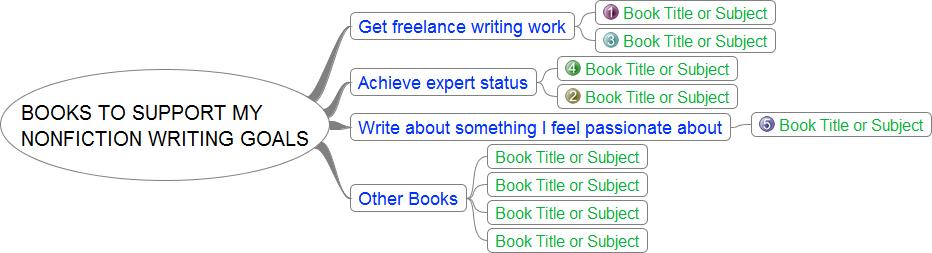
    Next, brainstorm tentative titles or subjects for books that would support those goals. Come up with at least one, preferably two for each goal. Prioritize them based on which will help you achieve your goal fastest. Here’s an example (without actual titles or subjects):Books for NF Writing GoalsIf you come up with other nonfiction book ideas you’d like to write during this process, write them down as well, but put them away for later. That’s what the “Other Books” category is for.  

    Nina’s newest book, The Author Training Manual is now available.  Be one of the first to own a copy of The Author Training Manual : Develop Marketable Ideas, Craft Books That Sell, Become the Author Publishers Want, and Self-Publish Effectively.

    Nina Amir Nina Amir, author of How to Blog a Book and The Author Training Manual, transforms writers into inspired, successful authors, authorpreneurs and blogpreneurs. Known as the Inspiration to Creation Coach, she moves her clients from ideas to finished books as well as to careers as authors by helping them combine their passion and purpose so they create products that positively and meaningfully impact the world. A sought-after author, book, blog-to-book, and results coach, some of Nina’s clients have sold 300,000+ copies of their books, landed deals with major publishing houses and created thriving businesses around their books. She writes four blogs, self-published 12 books and founded National Nonfiction Writing Month, aka the Write Nonfiction in November Challenge.


  • The following is from Nina Amir’s Blog, Write Nonfiction Now. Nina posts writing prompts on Fridays.  I really enjoyed Prompt #10 and thought you might like it, too.

    Create Book Ideas to Support Your Goals: Nonfiction Writing Prompt #10 by Nina Amir.

    If you want to write and publish books, the first step involves developing ideas. You may be a nonfiction writer with just one book idea or with many. However, if you have nonfiction writing goals, your book ideas should support your goals.

    I have many book ideas. Despite the fact that some of them really excite me, I have put quite a few on hold. I have them queued up in a logical order, one following the other so they help move me toward my goals.

    Sometimes those goals could be simple, such as get a traditional publishing deal. That may not sound “simple,” but, for example, I put aside some projects of mine that were outside my area of expertise to pursue that goal. I used my expertise to accomplish it. With traditionally published books under my belt that have performed well—a track record—I can move into other categories more easily, should I want to pursue traditional publishing for my other ideas. I can also pursue self-publishing now more successfully.

    Your goals could be to:

    • Attract more clients
    • Make more money
    • Develop authority
    • Tell your story
    • Serve others
    • Teach
    • Build a business around a book
    • Get more freelance assignments
    • Become a professional speaker

    Whatever your goals, it’s time to develop book ideas that support them.

    Write down your top two or three nonfiction writing goals. For each goal, also write down one or two reasons why you want to achieve that goal.

    Next, brainstorm tentative titles or subjects for books that would support those goals. Come up with at least one, preferably two for each goal. Prioritize them based on which will help you achieve your goal fastest.

    If you come up with other nonfiction book ideas you’d like to write during this process, write them down as well, but put them away for later.

    How many ideas did you come up with? Tell Nina in a comment by clicking here.  Scroll down to the bottom for the comments section. 

    Note:  Nina’s original post includes a chart and examples. . . to view the complete post, click here.

    Nina’s newest book, The Author Training Manual is now available.  Be one of the first to own a copy of The Author Training Manual : Develop Marketable Ideas, Craft Books That Sell, Become the Author Publishers Want, and Self-Publish Effectively.

    Nina Amir, author of How to Blog a Book and The Author Training Manual, transforms writers into inspired, successful authors, authorpreneurs and blogpreneurs. Known as the Inspiration to Creation Coach, she moves her clients from ideas to finished books as well as to careers as authors by helping them combine their passion and purpose so they create products that positively and meaningfully impact the world. A sought-after author, book, blog-to-book, and results coach, some of Nina’s clients have sold 300,000+ copies of their books, landed deals with major publishing houses and created thriving businesses around their books. She writes four blogs, self-published 12 books and founded National Nonfiction Writing Month, aka the Write Nonfiction in November Challenge.  Nina will be the November 20, 2014 Writers Forum Presenter.

    Nina Amir

  • Pat Olsen has written an excellent article about writing personal essay in the December 2013 issue of The Writer magazine. Highlights:

    “. . . when I am so obsessed about an idea that I can’t wait to put pen to paper, the essay almost writes itself. That’s not so say I don’t struggle over every word, or that I’m done after the first draft . . . Some of the best advice I’ve received is that it’s not only what you choose to include in an essay that’s important, but it’s also what you choose to omit.”  She gives an example and then goes on to ask:

    “Are there actual rules for essay writing? If so, not all writers agree on them.” After consulting essayists, here’s what she discovered:

     Kate Walter:  “‘An essay should have a universal theme . . . No matter how unusual a story may seem,’ she says, ‘there should be a broader theme that every reader can identify with.”

     Andrea King Collier:  “‘Voice is everything,’ she notes. ‘Two people can write an essay on the loss of a parent, and it is the voice and the approach/lens of the writer that can make one sing over the other.’”

     Bob Brody: “Start with an anecdote, a scene or an observation, Brody advises. Go back in time or stay in the present. Have a single big moment or a series of big moments.”

     Amy Paturel:  “The best essays, she says, are about a transformation. ‘Between the beginning and the end of your essay, there has to be some sort of epiphany or awakening . . . ”

     Andrea Cooper:  “. . . take a break from your essay. ‘I studied once with memoirist Patricia Hampl, who encouraged us to think of revision literally,’ she says. “It’s re-vision, re-seeing.’”

    Lots of good information in this article about writing personal essay.

     Nina Amir posts writing prompts on her blog.  Her January 31, 2014 post, about personal essays, includes Writing Prompt #9, Brainstorm Personal Essay topics.

    Nina writes, “Personal essays tend to focus on one particular event and how it affected you or your life. They often have universal themes that makes it possible for readers to relate to personal stories.”


  • B Lynn Goodwin

    What Would You Do With a Goal and a Deadline?

    Guest Blogger:

    NaNoWriMo, www.nanowrimo.org, invites you to draft a 50,000 word novel in one month. I’m doing it for the second time, and I’m going for higher word totals than the 1667 suggested daily allotment. I just want this first draft out of my head. I want material to work with.

    Not a fiction writer? You can still achieve a 30-day goal with memoir, biography, or any other form of non-fiction thanks to author and writing coach Nina Amir’s WINFIN, http://writenonfictioninnovember.com/about-2/. WINFIN (Write Nonfiction in November) is “an annual challenge to create a work of nonfiction in 30 days.”

    The rules are simple: Decide what you’re going to complete and go for it. You can create “an article, an essay, a book, a book proposal, a white paper, or a manifesto” The program “operates on an honor system…no word counts logged in here. It’s a personal challenge, not a contest.” Simply describe the nature of your project and come back at the end of the month and say how you did.

    Working on a memoir? Guest blogger Dennis Ledoux provides a day- by-day guide that conveniently runs for 30 days: http://writenonfictionnow.com/how-to-write-your-memoir-in-30-days-2/. November 1 is an arbitrary start date, of course. Pick your own starting day, but pick it soon, and commit yourself to working on the project for the next 30 days. Need weekends off? Commit yourself to working for the next 40 days.

    The author of the bestselling How to Blog a Book: How to Write, Publish and Promote Your Work One Post at a Time (Writer’s Digest Books), Nina Amir is a nonfiction editor, proposal consultant, author and book coach, and blog-to-book coach with more than 34 years of experience in the publishing field.

    The other day I thought about starting a National Journaling Month. Journaling primes the pump and greases the wheels. It gets writers started. It helps them dig deeper into their thoughts and find multi-dimensional truths. Participants in the National Journaling Month could record daily events, track their eating or exercising or arguing behaviors, analyze and resolve a decision about school or work or parenting, derail a negative thought pattern, or celebrate the joys of life. Journaling is an outstanding preparation for any writing project. It helps you figure out what you really want to say.

    Journaling for 30 days can achieve its own set of miracles, just like completing a non-fiction project or even writing a 50,000-word novel. Set a goal. Then share it with a community of writers. You’ll never know what you can accomplish if you dream of writing instead of actually doing it.

    B. Lynn Goodwin is the owner of Writer Advice, www.writeradvice.com, and the author of You Want Me to Do WHAT? Journaling for Caregivers, available on Amazon. Her stories and articles have been published in Voices of Caregivers; Hip Mama; the Oakland Tribune; the Contra Costa Times; the Danville Weekly; Staying Sane When You’re Dieting; Small Press Review; Dramatics Magazine; Career; We Care; Thickjam.com, Friction Literary Journal, and The Sun.

    A former teacher, she conducts workshops and writes reviews for Story Circle Network and InspireMeToday. She’s working on a YA novel and brainstorming a memoir.

  • Are you the type of person who needs to clear your desk before getting down to the business of writing?  Me, too. I have to pay the bills, sort, organize, stack things on my desk.  Satisfied, but not ready to get to writing, I look around. Oh, I really need to do the laundry, clean the bathroom, clean the floor, check the refrigerator, look outside, get a drink of water. Sometimes it seems I’ll do everything except write.

    One year I participated in NaNoWriMo for the month of November. I loved it. This year I’m going to participate in Write Nonfiction in November (WNFIN), founded by Nina Amir. But I know I’ll only be successful if I plan ahead.

    Here are Twelve Steps to get to that writing we so want to do.

    1. For the next two weeks, get caught up. Get organized, file those pieces of paper that clutter your desk, your counter, your life.

    2. For the next two weeks, spend extra time crossing things off your actual or mental to-do list. Whatever you’ve been putting off doing. . . do it now.

    3. Plan ahead. What do you usually do in November that you can do now? Put all the Thanksgiving and holiday items in a box (tablecloth, napkins, decorations, plates, etc).

    4. Get a box ready for all the incoming stuff. . . mail and paperwork that can wait until December.

    5. Get another box for important, don’t-want-to-forget items. As things arrive, put them here. Then, once a week in November, take care of business. . . spend as little time as possible. Just get this stuff done so you can get back to writing.

    6. Plan snacks. Make a list of perishable snacks you want to have on hand, so you don’t have to think when the time comes to purchase the snacks. Just take your list to the store. Then get back to writing.

    7. Plan meals. Same as above. Keep meals really easy. Soup and sandwiches. Simple salads.

    8. Purchase whatever you can now for your food needs/wants/cravings. Yes, you will have cravings. Plan for them. Don’t agonize over this. Keep your mind deep in the Land of Writing. But you will need motivation to keep going, not a reason to sneak off for ice cream.  Fill freezer, pantry and cupboards with food stuff you know you will want.

    9. Tell your friends and family whatever you want. . . you have a contagious disease, you have laryngitis, you’re on deadline (you are) . . . but you aren’t accessible to babysit, carpool, lend an ear or a shoulder. This is Your Time to write.

    10. Have everything lined up that you will need . . . paper, pens, ink cartridges, list of writing prompts as daily warm-ups, ashtray (just kidding, unless you really do smoke), water, snacks.

    11.  Turn your phone off, do not look at Facebook until the end of the day, do not get distracted with tweeting, twittering, looking, sneaking, freaking, or any of the many things that will tempt you to distraction.

    12.  Set up your good luck charms, talismans, touchstones, candles, lucky rabbit’s foot . . . whatever it takes to remind you . . . for the month of November. . . You Are A Writer.

    Write that on a post-it note. Post it prominently. Look at it. Remember it. Believe it. You Are A Writer.

    What helps you to keep focused on your writing? What steps would you add to being a successful writer?