
Guest Blogger Clara Rosemarda – writing with depth and clarity

  • ClaraGuest Blogger Clara Rosemarda reveals how to write with depth and clarity.

    Clara writes:

    Many years ago I took voice lessons from a master teacher. He worked with people
    who believed they were tone deaf. I was one of those people. My voice seemed flat as the ground I walked on, and I was too embarrassed to sing unless I was in a group large enough to swallow the sound of my voice.

    My teacher, robust and powerful, sat opposite me on the floor of his music studio. With full-bodied fingers born to make music he plucked the strings of his tambura going up and down the scale. Then he sounded a note and had me repeat it. At first I couldn’t reproduce the exact sound, but after a few tries and great concentration, I was able to. He told me I had a good voice which was a surprise to me. Once I got the hang of it, whenever I missed a note, he looked straight at me with his burning brown eyes, and asked where I had gone. Then he’d have me try again, and again, until I finally got it.

    These few lessons taught me that the problem was not with my voice, but my inability to stay focused and present. Although I was capable of deep concentration in many other areas, the life-long belief that I couldn’t sing disrupted my ability to listen and to replicate what I heard. Frightened that I would get it wrong, I tried to think my way through instead of trusting that if I listened I would be able to repeat the sound.

    Even though I don’t plan on giving a recital in Carnegie Hall or anywhere for that matter, I do enjoy singing now for the pure pleasure of it. Most importantly, I no longer consider myself tone deaf. I have developed the ability to concentrate when I’m singing, to listen deeply, and to be present with the sounds. When you are of two minds, neither one can be used to its fullest.

    The same is true with writing. When your mind is concentrated on a single thought or image, when you ARE the writing, and not jumping ahead of yourself, or thinking of HOW you are writing, you will write with depth and clarity.

    In the initial creation, all that is required is that you put pen to paper and keep your hand moving. Stay with your original thought, rather than allowing the editor to sit on your shoulder telling you not to say that, or how stupid this is, or what makes you think you’re a writer? To sound a clear note, you cannot be of two minds; your mind must be fully present and focused on a single point.

    EXERCISES:

    1. “His reflection in the mirror … ” Write for 1 0 minutes.
    2. “Walking through … ” Write for 15 minutes.
    3. “When I woke up that morning … ” Write for 20 minutes.
    4. Read these pieces aloud to yourself, listening mindfully, as if someone else had
      written them. What did you, the reader, hear that you didn’t hear as you were writing?

    CLARA ROSEMARDA M.A. is an evocative writing teacher, poet, memoirist, intuition counselor, and workshop leader. She has been in private practice in Santa Rosa, California for over thirty years where she works with beginning as well as mainstream writers. Clara teaches workshops at Santa Rosa Junior College and internationally. In her private sessions as well as her teaching she helps people connect to and act from their most authentic selves. She was co-creator and coordinator of the popular writers’ program, The Writer’s Sampler, of the Sebastopol Center for the Arts. Her prose and poetry are published in literary journals and anthologies. She is co-author and co-editor of the anthology, STEEPED: In the World of Tea (Interlink Publishing, 2004). Clara has two poetry chapbooks: “Doing Laundry” (a letterpress limited edition, Iota Press, 2013) and “Naked Branches” (WordTemple Press, Small Change Series, 2014).

    Note from Marlene:  If you have a chance to take a workshop with Clara. . . do it!  I did and it was a transformative experience.
  • How do you want to be remembered?

    Humorous or serious – what would you write for your epitaph?

    Compose several brief epitaphs for yourself — the headlines you’d like to see on your headstone. Think of them as messages to future generations that convey how you want to be remembered. And then. . . write a story that explains why the epitaph is appropriate.

    You could also write this for your fictional character.

    Here are some ideas:

    • He Was Happiest When He Was Young. Strongest When He Was Old.
    • Family First, Last, and Always
    • I’d Rather Be Smelling the Roses (Than Lying Underneath Them)
    • Wish I Had It All to Do Over Again (So I Could Do It All the Same but Better)

    From Family Tales, Family Wisdom —  How to gather the stories of a lifetime and share them with your family, by Dr. Robert U. Akeret with Daniel Klein


    Prompt #124

    Write your obituary, or your Life’s Tributes.  Share your writing here, on The Write Spot Blog.

  • What is your body telling you?

    For today’s writing . . . sit comfortably. Take a deep breath in. Let it out. Another deep, refreshing breath in. Release. One more big, nourishing breath. Let it whoosh out.

    Mentally scan your body. Become aware of any area that draws your attention – notice what part of your body calls out to you.

    Place the palm of your writing hand on the place that calls out. Or bring your breath there if it’s not reachable with your hand.

    Allow your hand to be filled with the information from that place.


    Prompt #123

    When you are ready, write about what you have discovered.

  • “When there is an obstacle, you have to rise to the challenge, not be overwhelmed by it. And we’re not alone in the world. I don’t know if there’s a name for that — religion or faith — just that there’s something greater than all of us, and it’s uniting and beautiful.” — Angelina Jolie, December 22, 2014 People magazine.

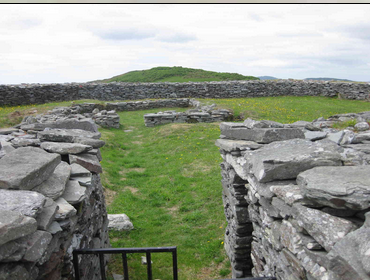
    March.stone wallFrom Marlene: Writing unites and connects us and that is, indeed, beautiful. When you reach an obstacle or challenge with your writing, see if you can work around it. Write sideways, in the margins. Come at the problem from a new angle. See the stumbling block as an opportunity to explore the problem and create a new solution. How? By doing a freewrite. Write down the first word that pops into your head and then write, for 12-15 minutes. Click here and here for more writing prompts. Just Write!

    Photo by Jim C. March

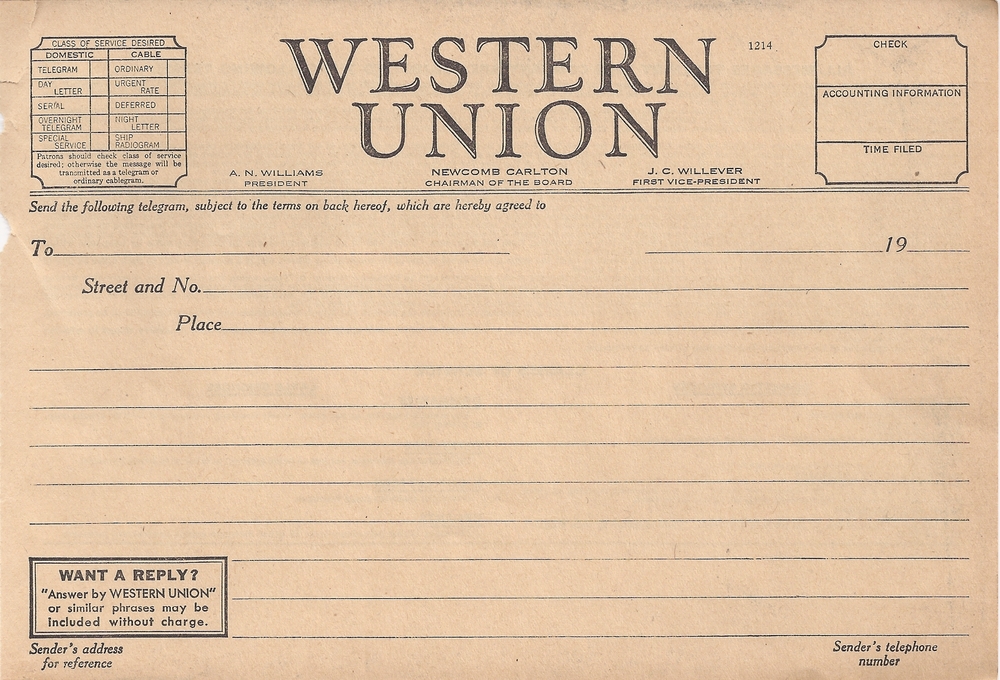
  • Write a telegram . . .

    Compose a telegram — a brief note that could be sent over the wires. Oh, I guess this sounds like an email, or a text message. But doesn’t “telegram” sound dramatic and perhaps romantic?

    Nostalgic for some people, a curiosity for others.

    Idea inspired from  From Family Tales, Family Wisdom —  How to gather the stories of a lifetime and share them with your family, by Dr. Robert U. Akeret with Daniel Klein


    Prompt #121

    So . . . write a telegram to someone who has touched your life in a significant way. Have your message tell him or her something you wish you could say in person. Or, if the person is no longer in your life, what do you wish you could have said?

    You could also write a telegram to or from your fictional character.

  • Write about something that happened . . .

    Write about something that happened to you this week. It can be something big, or something small. Maybe something you saw or observed. Perhaps something or someone touched you in a meaningful way. Write, using great detail. Or write sparse. Just write


    Photo by Breana Marie

    Prompt #120

    Write about something that happened to you this week.

  • scarves

    From Marlene: Your writing comes from memory, imagination, good times and bad. Share your memories through your writing. Create good times for readers. Weave your words, like threads on a loom, into a pattern that others can enjoy. Share your story.

  • Theodore Roosevelt.1“Far and away the best prize that life offers is the chance to work hard at work worth doing.” — Theodore Roosevelt, from a speech given in Syracuse, New York (September 7, 1903) From Real Simple magazine, September 2014

    Note from Marlene:  Your writing, your work matters.  Just write!

  • Write about a gift. . .


    Prompt #119

    Part 1:  Write about a gift someone gave you that you didn’t like, didn’t know what to do with or had no use for.

    Part 2:  What does this gift say about the person who gave it to you?
    Whenever there is a prompt like this, you can also write about the opposite.

    Part 1A: Write about a gift you loved, a gift that was a surprise in a good way, a gift that worked really well.
    Part 1B: What does this gift say about the person who gave it to you? 

  • Challenging situation. . .

    Sometimes you don’t know how you will act when faced with a difficult or a life threatening situation . . . until you are in the throes of it.  Write about a time you were in a challenging situation.  Use sensory detail.

    wonder woman

     OR:  Write about one of your fears. . . from a fictional character’s point of view. . . write about “the worst thing that can happen” . . . then, have your hero or heroine conquer the problem. Ready? Set? Okay. . . think about one of your fears that just won’t go away. Bring your character to life with those fearful thoughts and emotions. Now write. Just write!

    Captain America


    Challenging situation. . .

    This is similar to Prompt #47. . . only this time, have your character kick butt.