Today’s writing prompt: The next time . . .
“If you want to write about a ‘broken heart,’ it’s good to know what a broken heart feels like. I also believe you need to take the time and not rush things, keep it playful . . . and listen to the world around [you].”
— Jörgen Elofsson
Jörgen Elofsson, songwriter for Kelly Clarkson, excerpt from the May 2014 issue of The Writer Magazine.
Today’s prompt is inspired from the May 2014 issue of The Writer magazine.
Write about a character (real or fictional) surrounded by music. What instruments? What songs? Describe the soundtrack to the character’s story. How does music affect his or her actions, and what role does it play in the narrative?
More from this issue:
“Write the way people actually talk. You can use imagery and be poetic, of course, but the best lyrics sound like something people might actually say.” — Murray Horwitz, co-writer of the musical Ain’t Misbehavin’

Tips to writing deeply and comfortably.
Stretch – either standing or sitting in a chair. Do whatever whatever stretching feels good to you.
Sit easily in a comfortable chair.
Take a deep breath in through your nose, exhale out through your mouth, like you are blowing out a candle.
Take several deep breaths and whoosh out on the exhalations.
Relax into your chair. Smile. Escort your inner critic out the door.
Shed your ideas about what perfect writing means.
Give yourself permission to write the worst stuff possible.
Writing isn’t about talent, it’s about practice and going into another dimension.
Creative writing is an act of discovery.
Take another deep breath. Relax into your breathing. Exhale with a satisfying sigh.
Rather than write for an audience, write from an instinctual level.
Immerse yourself in writing. Let go of your worries and write. Just write to a satisfying inner desire to go to a meaningful place.
Go deeper into the recesses of your mind and really write.
Write from the well that stores the fears. Let the tears come. Let the stomach tie up in knots.
It’s okay to write the story that is difficult to tell.
Get through the barriers to go to a deeper level.
See your story and tell it.
When you are writing, if you run out of things to say, write “I remember. . .” and see where that takes you.
Or write, “What I really want to say . . .”
You can use the prompts on this blog to jumpstart your writing.

Photo by Jeff Cullen. Click here to see Jeff’s portfolio on fotolia.
Prompt: In a perfect world . . .
Set timer for 12 minutes. Write.
Post your writing here. Come on . . . share your writing with us.
In a perfect world . . .

Based on the poem, “Where I’m From,” by George Ella Lyon.
Learn more about this woman, with the unusual name (for a woman): George Ella Lyon.
“In the summer of 1993, I decided to see what would happen if I made my own where-I’m-from lists, which I did, in a black and white speckled composition book. I edited them into a poem — not my usual way of working — but even when that was done I kept on making the lists. The process was too rich and too much fun to give up after only one poem. Realizing this, I decided to try it as an exercise with other writers, and it immediately took off. The list form is simple and familiar, and the question of where you are from reaches deep.” George Ella Lyon
Watch and listen to George read her poem.
Note from Marlene: I had the good fortune to first hear this poem at a writing workshop with Pat Schneider. I’ve written on this prompt many times . . . each time I feel closer to the family I inherited.
I am from . . . Prompt #52

Prom, Tonga Room, Fairmont Hotel, San Francisco, 1965
Prompt #48 was about how to “Grow Your Character.” Prompt #49 was about setting the mood.
Today’s prompt is about “The Problem.” These series of prompts are based on Sheldon Siegel‘s 2011 Writers Forum workshop.
We’re working on how to write suspense, mystery, thriller. If that doesn’t interest you, you can also use these prompts to write memoir.
Write a one-sentence premise. What’s at stake? Why should the reader care?
If we follow along with Prompt #49: Our heroine is about to get into a limo to meet with Monsieur Blanchard. We know her father is concerned about her. We know she wants to look professional for this meeting. That’s about all we know.
Let’s play with this. What if our heroine is a contracted killer? What if she is meeting with Monsieur Blanchard to receive her next assignment? What if she needs the money because her father is in danger of losing their house for failure to pay back taxes? What if Monsieur Blanchard is about to blackmail her? What if she has information to blackmail him? All sorts of possibilities.
Premise: Our heroine, Monique, needs money to pay her father’s bills.
Stake: He could lose the house. She could lose her life.
Care: She will die.
When you are writing thriller, mystery or suspense, Sheldon says to know the enemy. Know who it is and what we’re scared of. Then you can manipulate the reader. Need to feel the enemy. Personified. Fear the murderer.
You can use your list of fears from Prompt #47 to incorporate with your character’s problem. Or you can think about your fears and work one of those into the premise.
Prompt: The problem is . . . Or, The problem was . . .
Note: If you are writing memoir, write what actually happened, as best remembered. Be sure to include details, such as character description and location. When writing about real people, they become “characters” in the story. Use sensory detail such as smell. Use the weather to mirror mood of character and of story.
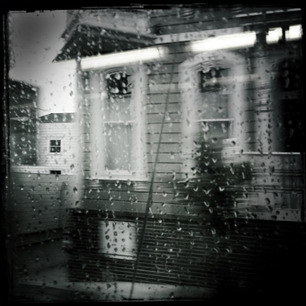
Photo by Sasha Oaks
Guest Blogger Patti Trimble asks, and answers, “Who cares if I write?”
Sometimes I ask myself, “Who cares if I write, who basically gives a damn anyway?” Then I remember this is a real question that should be asked with a radical change of voice. Who DOES care if I write? Exactly who am I writing for?
Writing is a mode of conversation: If I don’t know who I’m talking to, it hardly makes sense to speak.
Once, on a beach, not in this country, I watched twenty men pull in a surf net. At least that’s what I thought they were doing. For several hours I watched them pull—knee-deep in surf, hauling in two fat ropes that disappeared into the sea. As they inched backwards up the slope, one man jumped up; then some young people ran down to help pull. The town was into it because it was good work, hauling in sustenance from the depths.
I wouldn’t, couldn’t, write if I didn’t have someone—the whole town, or a few friends—helping me pull in stories and poems. I need my audience and I appreciate them. I ask strangers if they care about my topic—and why. I ask editors. I ask my mom. When I write, I address my audience. If I feel their enthusiasm, I want to write generous explanations, a funny line, a personal insight.
I also need to be honest about audience. If I was writing for the Nobel Committee, I’d have arranged my education, marriage, work schedule, and publicity machine accordingly. When I’m writing a love letter, I lower my voice . . .
Try it, try asking, “Who the hell cares if I write?” with curiosity and a sense of adventure. Make a list. Test a story on a friend. Write for someone who needs a laugh. Has your daughter heard about your 1980s hairdo? Does the city need your opinion on the asphalt plant? When your heart jumps at the flying geese, who’s jumping up to help pull out a poem? Is it your writer friends, next week’s slam audience, Mary Oliver, or your dad?
I’m just saying that writing is a collaborative process, and assembling your team makes things easier.
Patti Trimble is a freelance writer and widely-published poet. She often performs her lyric poems with music, and will have a new CD out in 2014. Patti teaches writing for Arcadia University in Sicily and also in the Bay Area, including an inspiring “mini-memoir” class that begins Jan 21 at Sonoma State Osher Program, and two spring workshops through Pt. Reyes Field Seminars.
What surprises me …
Guest Blogger Bella Andre shares what it takes to get writing.
In the workshops I give to writers, I talk a lot about blocking out the white noise (email, Facebook, phone calls, prolonged internet searches for information you don’t really need to know to write your first draft, etc.) and putting on blinders so you can really give your focus to your book. This advice is a lesson I personally relearn with every single book I write.
That’s the quick and pretty version, but if you pull back the glossy cover, the past 30 months actually look like this:
* Decide to start my new book.
* Do everything but start the book.
* Make more big plans to start the book, for real this time.
* Freak out about not starting the book.
* Tell myself that tackling the non-writing items on my enormous to-do list is important, necessary work, so really, how could I start the book yet?
* Tick through non-writing items on my to-do list and get crankier by the day.
* Force myself to sit down with my laptop and stare at the blank page and not get up until I’ve written at least 1,000 words.
* Finally realize (yet again!) that the number-one thing to help both my career and my peace of mind is sitting down and writing. Every single day. From one book to the next.
Today’s start of Sullivan #12 was no exception. I went through every one of the above steps during the past two weeks until I simply couldn’t stand it anymore. When I woke up this morning, I decided the to-do list could wait. Answering emails could wait. A walk could wait. Eating could wait.
But the book could not.
I truly believe that no matter where you are in your writing career, the book is always the most important thing. For a new writer, finishing your first book will likely require great focus and determination. All you want is to finally get to “The End.” But once your book is out in reader’s hands, the most important thing will always be your next book. I’ve seen again and again, in both my own career and others, that the surefire way to create ongoing success is to write the next book. And the one after that. And the one after that.
Once I finally push myself to start a new book, I always find that’s when the focus finally comes. Fortunately, day by day as I sink deeper into the manuscript, it becomes far easier to block out that white noise and keep focus on the writing.
Happy writing! Bella Andre.
Visit Bella’s Facebook Fan Page.
This “Pep Talk” originally appeared on National Novel Writing Month’s website, nanowrimo.org
Having sold more than 2.5 million self-published books, New York Times and USA Today bestselling author Bella Andre’s novels have appeared on Top 5 lists at Amazon, Apple, Barnes & Noble and Kobo. After signing a groundbreaking 7-figure print-only deal with Harlequin MIRA, Bella’s Sullivan series are being released in paperback in a major global English language launch in the US, Canada, the UK, and Australia in continuous back-to-back releases from June 2013 through April 2014. Known for “sensual, empowered stories enveloped in heady romance” (Publishers Weekly), her books have been Cosmopolitan Magazine “Red Hot Reads” twice and have been translated into nine languages, and her Sullivan books are already Top 20 bestsellers in Brazil. Winner of the Award of Excellence, The Washington Post has called her “One of the top digital writers in America” and she has been featured by NPR, USA Today, Forbes, The Wall Street Journal, and most recently in TIME Magazine. She has given keynote speeches at publishing conferences from Copenhagen to Berlin to San Francisco, including a standing-room-only keynote at Book Expo America on her self-publishing success.