Create a Hygge Calendar or List

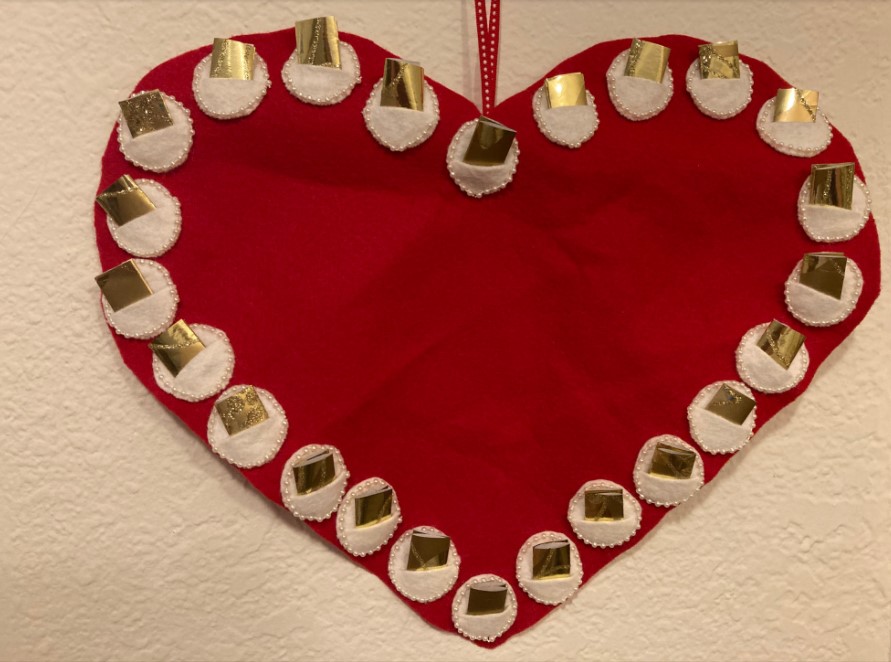
  • Photo and heart, by Susan Lawrence

    We hear a lot about being grateful, giving thanks, gratitude lists, and silver linings.

    But what if you just aren’t feeling it?

    How about creating a hygge calendar? I read about this in a Facebook group.

    Make a list of things to be mindful about, a way to help get out of the doldrums and into a feeling of calm, care, and positivity.

    Pay attention to one item each day.

    Personalize your calendar and use it as advent calendar, or as a way of looking at old things in a new way.

    Hygge: A quality of coziness and comfortable conviviality that engenders a feeling of contentment or well-being, regarded as a defining characteristic of Danish culture.

    Hygge Advent Calendar ideas, or a list of how to create a feeling of coziness:

    1. Light a candle during meals.

    2. Chalk a friendly greeting on a sidewalk.

    3. Share an uplifting poem or a story with friends.

    4. Bundle up and sit outside in the evening with twinkle lights.

    5. Read children’s books about Christmas and winter.

    6. Drive around and look at Christmas lights

    7. Hold or look at an item that belonged to a beloved family member, or a beloved friend.

    8. Phone a family member or a friend, just to say hello. Talk about a fun or memorable event you shared.

    9. Make something, it could be a baked item or a craft item.

    10. Sit outside for ten minutes and look at trees.

    11. Write a thank you note or a note just to say “Hi, I’m thinking about you.” Mail it!

    12. Boil cinnamon and orange peels to make the house smell good.

    13. Turn off all lights except for a candle or two (recommend battery operated). Get comfy under a warm blanket. Sit with the quiet.

    14. Look at family photos.

    15. Send a donation or donate your time to helping others.

    16. Make a nest of pillows and read a familiar and cozy book.

    17. Stand at a window and gaze at the view.

    18. Donate money or food to a food bank.

    19. Make paper snowflakes.

    20. Spend some time with a neighborhood pet.

    21. Take a few, deep, nourishing breaths. Breathe in. Breathe out.

    22. Soak feet in mineral salts while listening to music.

    23. Zoom into GROOVE dance with Diane Dupuis, Yoga with Adrienne, Feldenkrais, Insight Timer meditation.

    24. Write, using prompts from The Write Spot Blog.

    Thank you, Susan Lawrence, a speech therapist, in Los Angeles for this inspiration. Susan created her Hygge advent calendar by making a heart shaped wall hanging with pieces of gold paper, each one has a cozy activity written on it and placed in the pockets randomly.

  • By Ken Delpit

    Individual voices are fascinating. They reflect uniqueness.They involve specific characteristics and abilities, both physical and mental. In tone and in lyric, they express specific perspectives and emotions. They can be soft; they can be harsh. They can be musical to some, grating to others. They can be up-lifting, but also down-putting. Voices may not define us completely, but they certainly represent us while the rest of us waits backstage.

    But voices rarely come just one to a customer. Multiple voices can reside in a single person. This is certainly true for writers. Each fictional character, partially invented and partially native, taps into its writer’s own voice box. Voices within propel writers’ fingers, and shape their stories.

    With few exceptions, it is also true that everyone has multiple voices, whether writer or not. Anyone who hides true feelings or conceals real intentions uses a voice convenient for the deceit. Anyone who senses that they could inflict emotional damage may give their real voice the hook, and push a kinder understudy out as stand-in.

    United voices can swell the heart. They project multiplied energy.They promote commonality. They express hope and desire in ways that are much greater than the sum of their individual parts. And in a good way, they reduce us. They reduce us to not-so-different beings, with both interests and purposes in common.

    Then, too, united voices can be daunting. When assembled spontaneously, they can give birth to future planned gatherings. When unanimous in pain, they can startle us into action. When joined in purpose, they can change societies. When unified in anger, they can erupt in revolution.

    Voices. Both calming and rallying. Both music and weapon. Take care of your voice, as you would a fine French horn. Be careful with it, as you would a loaded revolver. And, remember to let it be silent much of the time. Absence of voice can often be the most commanding, and most harmonious, voice in your repertoire.

    Hearing voices” is sometimes a sign of losing it. While that may well be true in his case, Ken Delpit clings to the notion that being fascinated by the many voices that surround and lie within us helps with his writing. Ken hopes to promote himself beyond his technical background (computers, mathematics) into credible and imaginative science-fiction novels.

    “Voices” was inspired by Baba Yetu, Prompt #583 on The Write Spot Blog.

  • Guest Blogger Jenn Gott writes about 3 Inspiring Ways to Unlock the Book Inside You.

    Does this sound familiar: You’ve always been drawn to writing and have a mind brimming with ideas. You’ve always loved the idea of holding a book you have written — but somehow, despite all your best intentions and New Year’s Resolutions, it just hasn’t happened.

    Or maybe you’re a writer who has started a thousand writing projects, only to abandon them all within a few pages. Perhaps you’re not even sure if you want to be a writer, but you’ve always wanted to write a children’s book for your kids.

    Maybe you’re a poet, or a copywriter, or a journalist, and there’s a book you know you could write, if you just find the right words inside you.

    Maybe, maybe, maybe. One day.

    The trouble with “one day” is that it doesn’t exist — each day, there’s only today. Which is why I’m bringing you the three best practices that I’ve found to unlock and supercharge creativity. It doesn’t matter whether you’re a beginner who has always wanted to tell your story, or a seasoned pro who’s gotten mired in delays, worries, and self-doubt. Either way, these habits will have words flowing in no time.

    1. Find your community

    From National Novel Writing Month (NaNoWriMo) participants to your local writer’s group to authortube, it’s important to find your people wherever you can. Support is everything on your journey toward finishing a book, and it will inspire you more than anything else. To start, identify what kind of groups appeal most to you. Would you prefer to interact online,where you can hang out in your pajamas and reply at your leisure? Or would getting out of the house and seeing people face-to-face reinvigorate you? Are you interested in a classroom setting, a critique circle, or just some supportive friends who will provide lively discussion? Do you want to learn from people who are much more experienced than you, or strive together with peers at your skill level?

    Don’t feel you need to limit yourself to only one group. There’s nothing to keep you from making writer-friends on Twitter, and in person at bookish events, and through workshops. In fact, the more avenues you explore, the more likely you’ll find “your people.” Consider going to conferences, book signings, and events at your local library.

    Your community doesn’t need to be all writers. While it’s important to know some — to understand exactly what you’re going through, and bounce ideas off each other — a supportive and understanding friend or partner can go a long way. As you seek out connections, make sure to you surround yourself with people who believe in you. Remember, helpful and constructive criticism is good — how else can you learn the skills you’ll need to edit your book to perfection? But ragging on you and your work is toxic for everyone involved.

    2. Fill your creative well

    Sometimes the reason we’re not writing is simply that we’re emotionally tapped out. There are many factors that can cause creativity to dry up — everything from stress to poor mental health, to overwork, fatigue or illness, and creative burnout. And while it may feel silly to take time off to recharge if you haven’t been writing lately, sometimes that’s exactly what you need to do. Think of it like an arrow: pulling back first, in order to shoot forward.

    It’s important to make sure you’re recharging the right way, though. Scrolling through social media may be satisfying, but is it really going to inspire you to sit down at your laptop and write? Or would that time be better spent going for a walk, seeing a play, or reading an exquisitely written book?

    If you’re having trouble writing, take a minute to sit down and make a list of the things that energize you — physically, mentally, and creatively. Maybe plays aren’t your thing, but poetry is. Maybe a walk exhausts you, but yoga centers your mind. It really doesn’t matter what it is (truth be told, sometimes a movie or a video game inspires me). You just need to walk away from it refreshed, rejuvenated, and ready to tackle your big creative project.

    However, be careful not to let this turn into further procrastination. Remember, the point of these activities is to inspire you, not consume you. Always take a few minutes afterward to reflect on which parts of the experience spoke to you, and how you might use similar themes, moods, or ideas and blend them into your own work — or which mistakes you’ll want to avoid.

    3. Create your own writing retreat.

    Of course, we’d all love to go to a week-long retreat at a fancy cabin in the woods, but for many of us that simply isn’t an option. Luckily, there are ways to recreate the retreat feeling without venturing far from home or taking a lot of time out of your busy schedule.

    First, start by identifying any and all locations near you that might offer some peace and solitude. This can be as simple as locking your bedroom door, or as elaborate as a nice hotel nearby where you can book a room for a night or a weekend. Coffee shops, parks, or trains, and subways can do the trick, especially with a good pair of headphones! The point is to find someplace where you can block out thoughts of the outside world, including all your daily responsibilities. If you’re lucky enough to have a home office or a “room of one’s own,” try to find someplace else for your retreat — someplace you don’t work in every day.

    Next, consider what approach would best make that space feel more “writerly.” Would music help you, and if so, what kind? Would you feel more soothed with a soft blanket, a hot water bottle, or a big glass of wine? Candles, fairy lights, or other mood lighting can also help set the stage of your imagination. Remember, the point of this is to feel pampered, so don’t skimp on the creature comforts.

    Once you’ve identified where you’re going to take your “retreat” and how you’re going to cozy it up, the final step will be scheduling. This is, admittedly, the hardest part of your task, but with a bit of effort you can make it work. Try to block out a whole day, although even a few hours will be a huge boost.

    For magically productive people, just showing up might be enough to get the words flowing. For the rest of us, it might take a little more work, and a few handy tips and tricks. If you find yourself frozen at the prospect of getting started, consider freewriting as a warm up.

    Still unsure what to write about? Writing prompts might just be the kick your brain needs.

    Whatever you do, don’t stress out if your first “retreat” isn’t as fruitful as you’d imagined. Any progress is still progress, and the more often you repeat the writing habit — in any environment— the faster your creativity will kick into gear.

    Above all, remember: only you can tell your story. So, what are you waiting for? Get out there and tell your story. Today.


    Jenn Gott is an indie author and a writer with Reedsy, so she basically spends all her time either writing books, or helping people learn how to write books. She firmly believes there is no writing skill you cannot learn with practice and the right guidance. When she’s not working, she enjoys keeping up with the latest superhero movies, reading, and swimming.

  • The Write Spot Blog is all about writing: Writing Prompts to inspire you; Just Write tidbits to motivate you; Quotes to let you know others are in the same boat as you; Places to Submit to get your work out there; Book Reviews to share authors’ work; Guest Posts for all kinds of writing-related things.

    Today’s Guest Blog Post by Suzanne Murray talks about increasing your creativity by relaxing. Sounds easy, doesn’t it? But what about cortisol, adrenaline, and epigenetics? Factor those in, and it becomes apparent that relaxation isn’t as easy as drifting in a hammock.

    Fortunately, Suzanne Murray offers strategies to help us learn to relax. 

    HOW CREATIVITY CAN HELP US RELAX

    We all know that relaxation makes us and our bodies feel good whereas stress causes us to tense up and feel less that optimum. New scientific research shows just how important relaxing our bodies and minds is.

    The emerging science of epigenetics shows that our genetic expression is not permanently fixed at birth, but actually evolves as we grow and learn. Environmental factors including nutrition, stress and our emotional responses can affect how our genes express themselves without changing the basic blueprint of our DNA, the genetic material in our cells.

    When we are stressed our genes produce hormones associated with fight or flight like adrenalin and cortisol that are associated with aging and making us more susceptible to disease. When we are relaxed and feeling good our genes produce chemistry that boosts our immune system and helps with cellular repair and growth. 

    A study looking at mindfulness practices like meditation, yoga, breath work, and other relaxation techniques, showed that we can actually “turn on” disease-preventing genes and “turn-off” disease-causing genes through relaxing. Research on the energy psychology modality EFT (Emotional Freedom Techniques), an easy to use self-help strategy that combines western psychology with Chinese acupressure, found that an hour session of EFT lowered cortisol levels by 24 percent.

    I’d like to add creativity to ways we can relax as well as develop more of our potential.

    Creativity is really a form of mindfulness since it puts us in the flow of the moment and feels good. Adult coloring books have been shown to reduce stress. I like doodling or free writing where you just let the words flow out of the pen with no thought to what you are writing.

    Bringing play to whatever process you are working with and letting go of attachment to outcome is important.

    Stress so often stems from the fact that our mind has leapt ahead with worry about the future or is chewing over something that happened in the past. When we do things that bring us into the moment we naturally relax.

    Find what works for you. Play with it and see if you feel better.

    Suzanne Murray is a gifted creativity and writing coach, soul-based life coach, writer, poet, EFT practitioner and intuitive healer committed to empowering others to find the freedom to ignite their creative fire, unleash their imagination and engage their creative expression in every area of their lives. She works with simple, powerful techniques to help clear whatever gets in the way and creates a safe and sacred space for your creative and soulful life to blossom. She provides an experience of the joy and beauty that comes from embracing your gifts and expressing them in the world. With a lifelong connection to the natural world, she enjoys sharing the grace and wonder that Nature can bring to your life and creativity

     Writing and Creativity in Nature
    One Day Workshop Point Reyes CA
    April 22, 2017, 10 am to 4 pm

    Spending time in nature is good for our health, enhances our creative capacities and increases our general sense of wellbeing. It can help us enter the flow. Join me for this one day workshop where we will work with our creativity in the beauty of nature.

    EFT (Emotional Freedom Techniques)

    I’ve been working with EFT in new ways that allow us to laser in on the issue and shift it at the core. We often make significant shifts in a single session. Sessions are available by phone and Skype


    Original posted on Suzanne’s April 2, 2017 Blog


  • Excerpt from The Martian Chronicles by Ray Bradbury:There was a smell of Time in the air tonight.

    What did Time smell like? Like dust and clocks and people. And if you wondered what Time sounded like, it sounded like water running in a dark cave and voices crying and dirt dropping down upon hollow box lids, and rain. Time looked like snow dropping silently into a black room or it looked like a silent film in an ancient theatre one hundred billion faces falling like those New Year balloons down and down into nothing. That was how Time smelled and looked and sounded.

    HourglassMarlene’s Musings: I love the idea of writing what Time smells like. . . sounds like . . . looks like. . .

    Your Turn: Choose an item, an object, a thing, that interests you. . . what does it smell like? sound like? look like?

  • ClaraGuest Blogger Clara Rosemarda reveals how to write with depth and clarity.

    Clara writes:

    Many years ago I took voice lessons from a master teacher. He worked with people
    who believed they were tone deaf. I was one of those people. My voice seemed flat as the ground I walked on, and I was too embarrassed to sing unless I was in a group large enough to swallow the sound of my voice.

    My teacher, robust and powerful, sat opposite me on the floor of his music studio. With full-bodied fingers born to make music he plucked the strings of his tambura going up and down the scale. Then he sounded a note and had me repeat it. At first I couldn’t reproduce the exact sound, but after a few tries and great concentration, I was able to. He told me I had a good voice which was a surprise to me. Once I got the hang of it, whenever I missed a note, he looked straight at me with his burning brown eyes, and asked where I had gone. Then he’d have me try again, and again, until I finally got it.

    These few lessons taught me that the problem was not with my voice, but my inability to stay focused and present. Although I was capable of deep concentration in many other areas, the life-long belief that I couldn’t sing disrupted my ability to listen and to replicate what I heard. Frightened that I would get it wrong, I tried to think my way through instead of trusting that if I listened I would be able to repeat the sound.

    Even though I don’t plan on giving a recital in Carnegie Hall or anywhere for that matter, I do enjoy singing now for the pure pleasure of it. Most importantly, I no longer consider myself tone deaf. I have developed the ability to concentrate when I’m singing, to listen deeply, and to be present with the sounds. When you are of two minds, neither one can be used to its fullest.

    The same is true with writing. When your mind is concentrated on a single thought or image, when you ARE the writing, and not jumping ahead of yourself, or thinking of HOW you are writing, you will write with depth and clarity.

    In the initial creation, all that is required is that you put pen to paper and keep your hand moving. Stay with your original thought, rather than allowing the editor to sit on your shoulder telling you not to say that, or how stupid this is, or what makes you think you’re a writer? To sound a clear note, you cannot be of two minds; your mind must be fully present and focused on a single point.

    EXERCISES:

    1. “His reflection in the mirror … ” Write for 1 0 minutes.
    2. “Walking through … ” Write for 15 minutes.
    3. “When I woke up that morning … ” Write for 20 minutes.
    4. Read these pieces aloud to yourself, listening mindfully, as if someone else had
      written them. What did you, the reader, hear that you didn’t hear as you were writing?

    CLARA ROSEMARDA M.A. is an evocative writing teacher, poet, memoirist, intuition counselor, and workshop leader. She has been in private practice in Santa Rosa, California for over thirty years where she works with beginning as well as mainstream writers. Clara teaches workshops at Santa Rosa Junior College and internationally. In her private sessions as well as her teaching she helps people connect to and act from their most authentic selves. She was co-creator and coordinator of the popular writers’ program, The Writer’s Sampler, of the Sebastopol Center for the Arts. Her prose and poetry are published in literary journals and anthologies. She is co-author and co-editor of the anthology, STEEPED: In the World of Tea (Interlink Publishing, 2004). Clara has two poetry chapbooks: “Doing Laundry” (a letterpress limited edition, Iota Press, 2013) and “Naked Branches” (WordTemple Press, Small Change Series, 2014).

    Note from Marlene:  If you have a chance to take a workshop with Clara. . . do it!  I did and it was a transformative experience.

  • How do you want to be remembered?

    Humorous or serious – what would you write for your epitaph?

    Compose several brief epitaphs for yourself — the headlines you’d like to see on your headstone. Think of them as messages to future generations that convey how you want to be remembered. And then. . . write a story that explains why the epitaph is appropriate.

    You could also write this for your fictional character.

    Here are some ideas:

    • He Was Happiest When He Was Young. Strongest When He Was Old.
    • Family First, Last, and Always
    • I’d Rather Be Smelling the Roses (Than Lying Underneath Them)
    • Wish I Had It All to Do Over Again (So I Could Do It All the Same but Better)

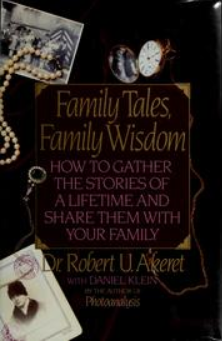
    From Family Tales, Family Wisdom —  How to gather the stories of a lifetime and share them with your family, by Dr. Robert U. Akeret with Daniel Klein


    Prompt #124

    Write your obituary, or your Life’s Tributes.  Share your writing here, on The Write Spot Blog.

  • Natalie GoldbergWriting Down the Bones.

    Natalie Goldberg

    Nat’s quote perfectly describes what a free write can do . . . opens us up to ideas and thoughts that lie within us.  Try it. Go to the prompts category here or here and choose a prompt. Then write . . . freely. Just Write!

  • What is your body telling you?

    For today’s writing . . . sit comfortably. Take a deep breath in. Let it out. Another deep, refreshing breath in. Release. One more big, nourishing breath. Let it whoosh out.

    Mentally scan your body. Become aware of any area that draws your attention – notice what part of your body calls out to you.

    Place the palm of your writing hand on the place that calls out. Or bring your breath there if it’s not reachable with your hand.

    Allow your hand to be filled with the information from that place.


    Prompt #123

    When you are ready, write about what you have discovered.

  • Gifts!


    Prompt #122

    Write about one or more:

    • The most disappointing gift you have received and what it revealed about the giver.
    • The most unusual gift you have received, or given.
    • The most wonderful gift you have received, or given.
    • Write about intangible gifts.