All Fools Day . . . Prompt #58

  • The roots of All Fools Day date back to at least the 1500s as an occasion to perpetrate tomfoolery, possibly in reaction to spring’s mercurial weather. It’s observed on April 1 in many Western countries.

    In Italy, France, Belgium, and French-speaking areas of Switzerland and Canada, pranksters cry “April fish” as they tape paper fish to people’s backs.

    In 1957, the BBC pulled a prank, known as the Swiss Spaghetti Harvest prank, where they broadcast a fake film of Swiss farmers picking freshly-grown spaghetti. The BBC were later flooded with requests to purchase a spaghetti plant, forcing them to declare the film a prank on the news the next day.

    Source:  Wikipedia 

    Prompt:  Write about pranks you used to play on April Fool’s Day, a prank pulled on you, or make up a story about how April Fool’s Day started.

    Court Jester

  • This prompt is inspired by Ianthe Brautigan from her Writers Forum workshop.

    Draw a circle with radiating arms, ending in circles (see below).

    In the center circle, write a note about a watershed moment where nothing was the same after that: A pivotal moment.

    Write details on the radiating circles. Include as many circles as you want for details.

    Write into the questions  . . . how did this moment shape me? How did this affect the rest of my life?

    Use this prompt to spark a freewrite.

    When you are finished with freewriting on this prompt, if you keep a journal, use that for details to flesh out the story.

    water circles new

  • Tips to writing deeply and comfortably.

    Stretch – either standing or sitting in a chair. Do whatever whatever stretching feels good to you.

    Sit easily in a comfortable chair.

    Take a deep breath in through your nose, exhale out through your mouth, like you are blowing out a candle.

    Take several deep breaths and whoosh out on the exhalations.

    Relax into your chair.  Smile.  Escort your inner critic out the door.

    Shed your ideas about what perfect writing means.

    Give yourself permission to write the worst stuff possible.

    Writing isn’t about talent, it’s about practice and going into another dimension.

    Creative writing is an act of discovery.

    Take another deep breath. Relax into your breathing. Exhale with a satisfying sigh.

    Rather than write for an audience, write from an instinctual level.

    Immerse yourself in writing. Let go of your worries and write. Just write to a satisfying inner desire to go to a meaningful place.

    Go deeper into the recesses of your mind and really write.

    Write from the well that stores the fears. Let the tears come. Let the stomach tie up in knots.

    It’s okay to write the story that is difficult to tell.

    Get through the barriers to go to a deeper level.

    See your story and tell it.

    When you are writing, if you run out of things to say, write “I remember. . .” and see where that takes you.

    Or write, “What I really want to say . . .”

    You can use the prompts on this blog to jumpstart your writing.

    beach filled heart

    Photo by Jeff Cullen. Click here to see Jeff’s portfolio on fotolia.

  • The following is from Nina Amir’s Blog, Write Nonfiction Now. Nina posts writing prompts on Fridays.  I really enjoyed Prompt #10 and thought you might like it, too.

    Create Book Ideas to Support Your Goals: Nonfiction Writing Prompt #10 by Nina Amir.

    If you want to write and publish books, the first step involves developing ideas. You may be a nonfiction writer with just one book idea or with many. However, if you have nonfiction writing goals, your book ideas should support your goals.

    I have many book ideas. Despite the fact that some of them really excite me, I have put quite a few on hold. I have them queued up in a logical order, one following the other so they help move me toward my goals.

    Sometimes those goals could be simple, such as get a traditional publishing deal. That may not sound “simple,” but, for example, I put aside some projects of mine that were outside my area of expertise to pursue that goal. I used my expertise to accomplish it. With traditionally published books under my belt that have performed well—a track record—I can move into other categories more easily, should I want to pursue traditional publishing for my other ideas. I can also pursue self-publishing now more successfully.

    Your goals could be to:

    • Attract more clients
    • Make more money
    • Develop authority
    • Tell your story
    • Serve others
    • Teach
    • Build a business around a book
    • Get more freelance assignments
    • Become a professional speaker

    Whatever your goals, it’s time to develop book ideas that support them.

    Write down your top two or three nonfiction writing goals. For each goal, also write down one or two reasons why you want to achieve that goal.

    Next, brainstorm tentative titles or subjects for books that would support those goals. Come up with at least one, preferably two for each goal. Prioritize them based on which will help you achieve your goal fastest.

    If you come up with other nonfiction book ideas you’d like to write during this process, write them down as well, but put them away for later.

    How many ideas did you come up with? Tell Nina in a comment by clicking here.  Scroll down to the bottom for the comments section. 

    Note:  Nina’s original post includes a chart and examples. . . to view the complete post, click here.

    Nina’s newest book, The Author Training Manual is now available.  Be one of the first to own a copy of The Author Training Manual : Develop Marketable Ideas, Craft Books That Sell, Become the Author Publishers Want, and Self-Publish Effectively.

    Nina Amir, author of How to Blog a Book and The Author Training Manual, transforms writers into inspired, successful authors, authorpreneurs and blogpreneurs. Known as the Inspiration to Creation Coach, she moves her clients from ideas to finished books as well as to careers as authors by helping them combine their passion and purpose so they create products that positively and meaningfully impact the world. A sought-after author, book, blog-to-book, and results coach, some of Nina’s clients have sold 300,000+ copies of their books, landed deals with major publishing houses and created thriving businesses around their books. She writes four blogs, self-published 12 books and founded National Nonfiction Writing Month, aka the Write Nonfiction in November Challenge.  Nina will be the November 20, 2014 Writers Forum Presenter.

    Nina Amir

  • Tell a story from your past that has something to do with being a klutz or a time you were dazzling.

    Green Thing

  • Prompt #48 was about how to “Grow Your Character.”  Prompt #49 was about setting the mood. Prompt #50 was “The Problem.”

    Let’s put them all together and write the scene.  If you have freewrites on character, mood and a problem. . . use these elements to write a scene. Or, write a scene, using all new material.

    If writing memoir, write what actually happened, as best as remembered. Be sure to include details. Be specific. Not “car,” rather “1966 blue Dodge van.”

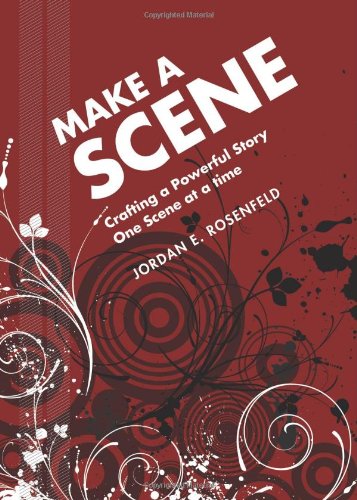
    “Scenes are capsules in which compelling characters undertake significant actions in a vivid and memorable way that allows the events to feel as though they are happening in real time. When strung together, individual scenes add up to build plots and storylines.  — Make A Scene, Crafting a powerful Story One Scene at a Time,  by Jordan E. Rosenfeld

    In Make A Scene, Jordan includes a recipe for basic ingredients for compelling scenes. If you are looking for an excellent book on how to write, this is it! Click here for my review of Make A Scene.

    Make A Scene.Rosenfeld

  • Grow your characters.

    For the next three writing prompts, we’re going to build our repertoire, so that we’ll have characters, location and a problem leading us to write a scene.

    One step at a time.

    First step:  Write a brief description of character or characters.  If  you have a work in progress, use this time to discover something new about your characters. If writing memoir, same thing . . . find a new way to describe character.  Include flaw or flaws.

    Example:  Self-doubt, what would be challenging to character?  What does the character fear? What big events molded character? Character’s likes and dislikes.  What drives character? How does character react to pressure? Give your character a personality quirk, add internal conflict. These examples are from Sheldon Siegel’s 2011 talk at Writers Forum of Petaluma.  Sheldon Siegel is one of my favorite authors.

    Need more ideas? Fill in the blanks. Answer these questions for each of your characters.

    Character’s name
    Nickname

    Personality trait character is most proud of.

    How did character get this trait?

    What do people like least about character?

    What habit would character like to change?

    If someone looked in character’s bathroom garbage right now, what would they find?

    What scent does character like and what does it remind him/her of?

    What scares the character?

    Answer these questions for each of your characters (whether fictional or real). Real people become “characters” in your story once you start writing about them.

    For more prompts about character:

    Develop Character, put your character in an unusual situation and see what happens – Prompt #4

    Interview Character – Prompt #6

    Your Character Has A Surprise Secret – Prompt #7

  • Memories


    Prompt #29

    Today’s prompt:  Memories

  • Today I feel . . .

    Today’s prompt is inspired from You Want Me To Do What? Journaling for Caregivers (available on Amazon) by B. Lynn Goodwin, founder of Writer Advice,  promoting authors through interviews. Writer Advice also publishes experienced and emerging writers, showcasing fresh ideas and high quality writing.


    Prompt #20

    Today I feel . . .

  • Welcome

    Welcome! I’m so excited for you to be here. . . a place to learn about writing, use prompts to inspire your writing, and places to submit your writing. We’re all about writing.

    Ready? Pen and paper nearby? Computer warming up? Flex hands, fingers poised . . .


    Book

    First prompt

    I remember. . .

    Go! Write!