Take Your Writing to the Next Level

  • Guest Blogger B. Lynn Goodwin talks about Taking Your Writing to the Next Level – A Look at Editing and Polishing

    So you’ve been inspired, found the time, and drafted a story or memoir that you really want to share with the world. Maybe you’ve even shared it with a critique group, or had a good friend read it to you so you could hear your own glitches.

    What do you need to do to take it to the next level and make it ready for publication?

    1.  Look at the content. Does everything contribute to the story you’re telling, or do you have extraneous material?
    2. Do your characters struggle, try, and give it their all? If not, is there a clear reason not to? Does that change before the end of the story?
    3. Now that you’ve drafted it, what is your story about? It might have several themes or messages. Make a list.
    4. How does the story end? Is there an epiphany? Does the ending reinforce your message? Has the protagonist changed?
    5. Do you feel stuck? Try listing 5-20 things that aren’t likely to happen. It’s a circuitous route for opening yourself to new ideas.
    6. Why is this story important? What matters? What’s at stake?
    7. What makes this story unique and what makes it universal?
    8. Is there some kind of tension and how does it enhance the story? Does the pace work?
    9. Are your mechanics polished until they shine? Do they make you look professional?
    10. Who is your audience and why will they care about these characters and their situation?
    11. How will your audience find this story? Who can help you bring it to them?
    12. Condense your story into 45 words or less. That’s your pitch, the speech you use to tell your story. If you can’t do that, what do you need to cut, and what do you need to sharpen?

    Sharing with readers is different from sharing with writers. Readers can tell you what they like and what troubles them. Writers and editors can tell you how to fix those problems. You might consider sharing with both before you submit.

    Then make a list of ten magazines or e-zines or editors you’ll send it out to. As soon as it’s gone out, make a list of another ten. That way if you get a rejection, you can keep sending it out. Be sure you send to places that are looking for your subject matter, your style, and your level of skill.

    Be courageous, not arrogant, whether you’re responding to acceptances, fan mail, or even rejections. And keep writing, even on the days when you’re down and discouraged. As my husband says, “You don’t lose until you quit trying.”
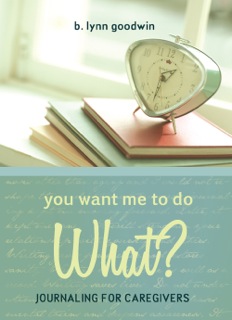
    !cid_5B86196A-44C5-4B34-805E-083B7A5FCE2C@hsd1_ca_comcast_netLynn Goodwin is the owner of Writer Advice, www.writeradvice.com, which is currently holding its 10th Flash Prose Contest. She’s the author of You Want Me to Do WHAT? Journaling for Caregivers,  and a YA called Talent, which Eternal Press will be publishing this year. Her short pieces have been published in local and regional publications.

    Lynn will be on a panel of editors at Writers Forum in Petaluma, California on May 21, 2015.

  • Today I know . . .

    Today’s prompt is inspired by B. Lynn Goodwin, owner of Writer Advice, and the author of You Want Me to Do WHAT? Journaling for Caregivers, available on Amazon.


    Prompt #22

    Prompt:  Today I know . . .

  • Yesterday I believed . . . The truth is . . .

    Writing prompts inspired from You Want Me To Do What? Journaling for Caregivers by B. Lynn Goodwin.


    Prompt #21

    Yesterday I believed . . .  The truth is . . .

  • Today I feel . . .

    Today’s prompt is inspired from You Want Me To Do What? Journaling for Caregivers (available on Amazon) by B. Lynn Goodwin, founder of Writer Advice,  promoting authors through interviews. Writer Advice also publishes experienced and emerging writers, showcasing fresh ideas and high quality writing.


    Prompt #20

    Today I feel . . .

  • B Lynn Goodwin

    What Would You Do With a Goal and a Deadline?

    Guest Blogger:

    NaNoWriMo, www.nanowrimo.org, invites you to draft a 50,000 word novel in one month. I’m doing it for the second time, and I’m going for higher word totals than the 1667 suggested daily allotment. I just want this first draft out of my head. I want material to work with.

    Not a fiction writer? You can still achieve a 30-day goal with memoir, biography, or any other form of non-fiction thanks to author and writing coach Nina Amir’s WINFIN, http://writenonfictioninnovember.com/about-2/. WINFIN (Write Nonfiction in November) is “an annual challenge to create a work of nonfiction in 30 days.”

    The rules are simple: Decide what you’re going to complete and go for it. You can create “an article, an essay, a book, a book proposal, a white paper, or a manifesto” The program “operates on an honor system…no word counts logged in here. It’s a personal challenge, not a contest.” Simply describe the nature of your project and come back at the end of the month and say how you did.

    Working on a memoir? Guest blogger Dennis Ledoux provides a day- by-day guide that conveniently runs for 30 days: http://writenonfictionnow.com/how-to-write-your-memoir-in-30-days-2/. November 1 is an arbitrary start date, of course. Pick your own starting day, but pick it soon, and commit yourself to working on the project for the next 30 days. Need weekends off? Commit yourself to working for the next 40 days.

    The author of the bestselling How to Blog a Book: How to Write, Publish and Promote Your Work One Post at a Time (Writer’s Digest Books), Nina Amir is a nonfiction editor, proposal consultant, author and book coach, and blog-to-book coach with more than 34 years of experience in the publishing field.

    The other day I thought about starting a National Journaling Month. Journaling primes the pump and greases the wheels. It gets writers started. It helps them dig deeper into their thoughts and find multi-dimensional truths. Participants in the National Journaling Month could record daily events, track their eating or exercising or arguing behaviors, analyze and resolve a decision about school or work or parenting, derail a negative thought pattern, or celebrate the joys of life. Journaling is an outstanding preparation for any writing project. It helps you figure out what you really want to say.

    Journaling for 30 days can achieve its own set of miracles, just like completing a non-fiction project or even writing a 50,000-word novel. Set a goal. Then share it with a community of writers. You’ll never know what you can accomplish if you dream of writing instead of actually doing it.

    B. Lynn Goodwin is the owner of Writer Advice, www.writeradvice.com, and the author of You Want Me to Do WHAT? Journaling for Caregivers, available on Amazon. Her stories and articles have been published in Voices of Caregivers; Hip Mama; the Oakland Tribune; the Contra Costa Times; the Danville Weekly; Staying Sane When You’re Dieting; Small Press Review; Dramatics Magazine; Career; We Care; Thickjam.com, Friction Literary Journal, and The Sun.

    A former teacher, she conducts workshops and writes reviews for Story Circle Network and InspireMeToday. She’s working on a YA novel and brainstorming a memoir.